

SWOFON Raises Alarm Over Decline in Anambra Agricultural Funding
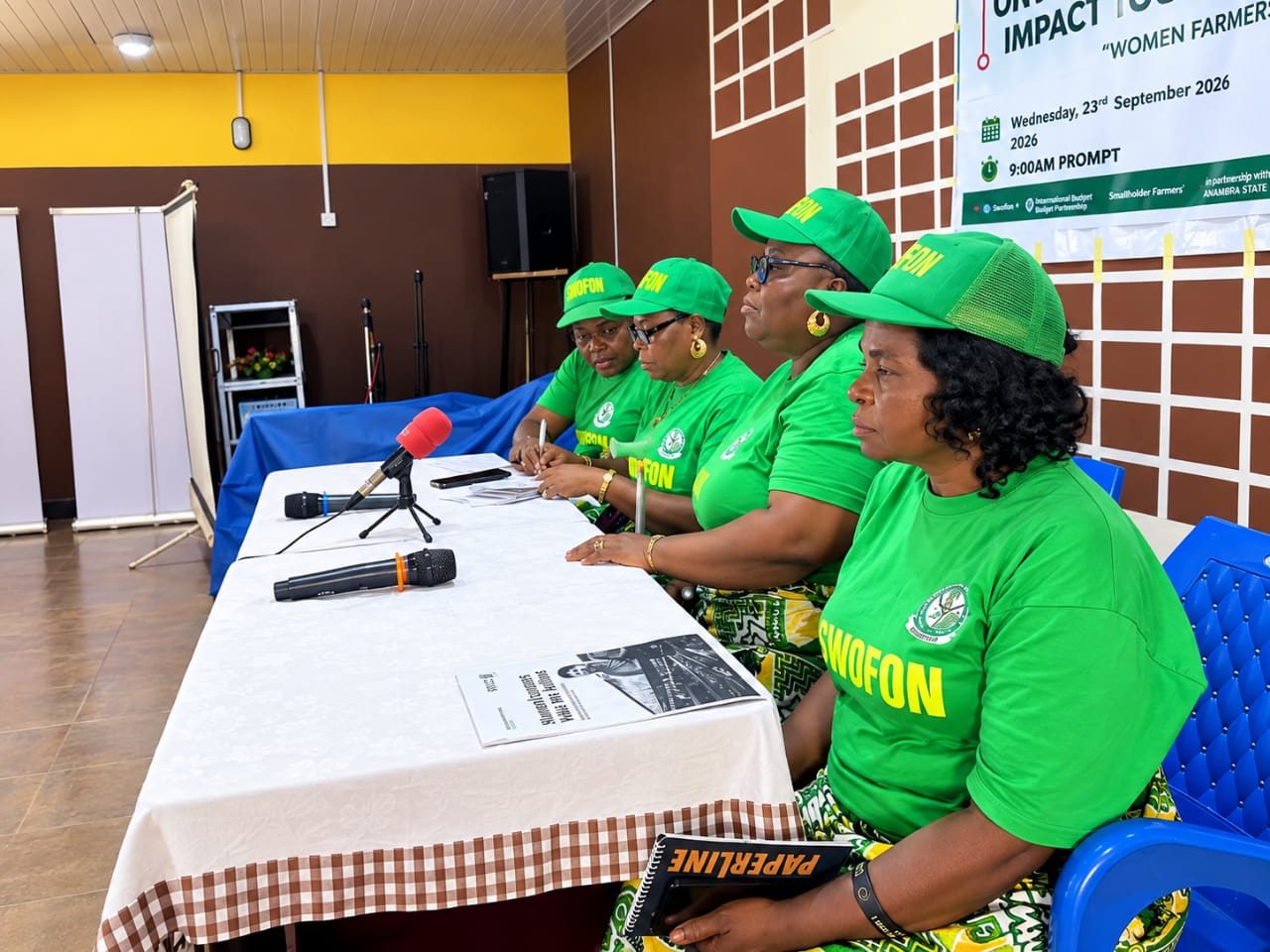
The Small-Scale Women Farmers Organisation in Nigeria (SWOFON) has raised concerns over the declining share of Anambra State’s budget allocated to agriculture, saying stronger public investment and improved budget implementation are needed to support smallholder farmers.
According to the IBP-SWOFON Impact Assessment, 2019–2025, Anambra allocated 2.03 per cent of its approved state budget to agriculture in 2021, 1.90 per cent in 2022, 0.97 per cent in 2023, 0.68 per cent in 2024 and 0.59 per cent in 2025.
The assessment used the African Union’s Maputo/Malabo 10 per cent agricultural expenditure commitment as an advocacy benchmark and estimated that Anambra’s 2025 allocation represented a gap of N57.12 billion from the benchmark.
It, however, cautioned that differences in state budget classifications mean the comparison should be regarded as indicative rather than a definitive measure of compliance.
Beyond allocations, SWOFON said the implementation of approved agricultural capital expenditure remained a major concern.
The assessment found that between 2021 and 2025, Anambra recorded N10.97 billion in approved agricultural capital expenditure but only N3.21 billion in reported actual spending, representing an execution rate of 29.3 per cent.
The organisation said the figures highlighted the difference between approving funds and ensuring that the resources translate into services, infrastructure and productive opportunities for farmers.
For smallholder women farmers, SWOFON said poor implementation could affect access to equipment, farm inputs, extension services, finance, land, irrigation, storage, processing facilities and markets.
The organisation said its Charter of Demands, developed through consultations with women farmers, was submitted to and acknowledged by relevant government institutions in Anambra.
However, the assessment found no traceable state appropriation line directly linked to the Charter of Demands.
It noted that some support received by women farmers in the state came through federal programmes rather than through a clearly identifiable state budget response to the charter.
SWOFON said this distinction was important because women farmers needed to know what had been budgeted, where the allocation appeared in the budget, the responsible institution, implementation timeline and intended beneficiaries.
The assessment also documented instances of support reaching women farmers.
In May 2025, SWOFON members in Anambra East Local Government Area participated in training on agricultural product packaging and value addition, with a proposed N3 million financing package structured as a 30 per cent grant and 70 per cent interest-free loan.
In January 2026, the Federal Ministry of Agriculture and Food Security distributed new knapsack sprayers to more than 50 farmer groups and cooperative societies across Anambra.
SWOFON’s Anambra Coordinator indicated that the equipment would be shared among SWOFON members across the state’s 21 local government areas.
The organisation said such interventions demonstrated that agricultural support could reach organised women farmers, but stressed the need for predictable and sustainable state-level systems.
SWOFON therefore called for institutionalised participation of women farmers in the budget cycle at state and local government levels.
It also urged government to convert priority demands into identifiable and costed budget lines, improve agricultural budget execution and transparency, strengthen women’s access to productive resources and establish mechanisms through which beneficiaries can monitor projects and services.
The organisation said women’s participation in budget and policy processes had improved across the five states covered by the assessment, but participation needed to translate into identifiable commitments and measurable delivery.
It urged the Anambra State Government, relevant ministries, departments and agencies, the State Legislature, Local Government Councils and other stakeholders to work with organised women farmers to strengthen gender-responsive agricultural budgeting.
SWOFON said the objective should be to ensure that women’s priorities are reflected not only in consultations but also in budgets, programmes, implementation and results.