

Anambra Stakeholders Validate Menstrual Health Policy, Clear Path to Adoption
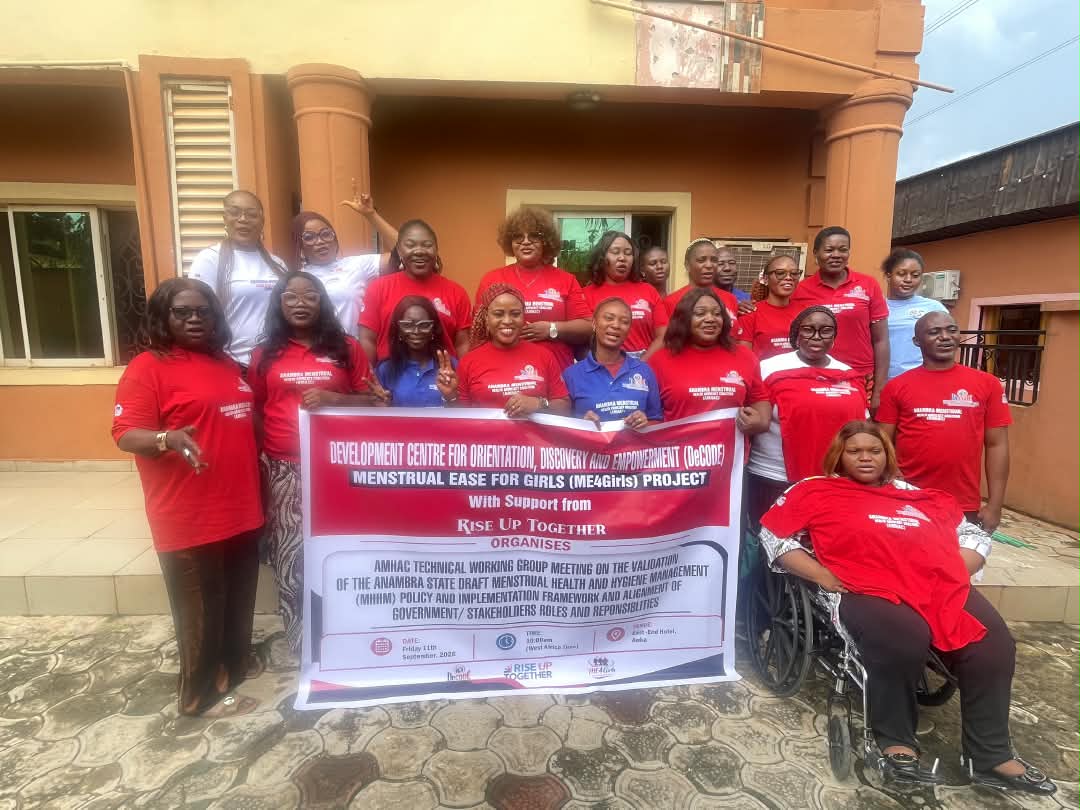
The Anambra State Government has taken a significant step towards adopting a comprehensive Menstrual Health and Hygiene Management (MHHM) Policy following the validation of the draft policy and its implementation framework by key stakeholders.
The validation was held at a technical meeting convened by the Anambra Menstrual Health Advocacy Coalition (AMHAC) Technical Working Group through the Development Centre for Orientation, Discovery and Empowerment (DeCODE) under the Menstrual Ease for Girls (ME4Girls) Project, with support from Rise Up Together.
The meeting brought together representatives of government ministries, education agencies, health institutions, civil society organisations and the media to review the draft policy and agree on a framework for its implementation.
Stakeholders also examined findings from the Anambra State Menstrual Health Situation Assessment, which assessed menstrual health challenges, service gaps and opportunities across six local government areas and 12 public secondary schools.
The assessment provided the evidence base for refining the proposed policy.
Discussions focused on institutional responsibilities, financing, coordination, phased implementation, monitoring and accountability required to translate the policy into effective action.
Under the proposed framework, the Ministry of Women Affairs and Social Welfare will provide overall leadership for policy adoption and coordinate implementation at the state level.
The Ministry of Education will oversee implementation within schools in collaboration with the Post-Primary Schools Service Commission (PPSSC) and the Anambra State Universal Basic Education Board (ASUBEB), while the Ministry of Health will provide technical guidance on health-related components.
The Rural Water Supply and Sanitation Agency (RUWASSA) will support water, sanitation and hygiene infrastructure to promote safe and menstrual-friendly learning environments.
Civil society organisations and the media are expected to complement government efforts through advocacy, community engagement, public awareness, evidence generation, monitoring and accountability.
At the end of the meeting, members of the AMHAC Technical Working Group validated the draft policy and implementation framework, subject to the incorporation of technical recommendations and further refinement.
They also resolved to strengthen inter-ministerial collaboration and ensure that the final policy includes clear timelines, resource considerations and accountability mechanisms.
The next phase of the process will involve finalising the policy documents and preparing a proposal for submission to Governor Chukwuma Soludo and the Anambra State Executive Council for consideration.
Stakeholders noted that menstrual health is a cross-sectoral issue requiring coordinated action to ensure girls have access to menstrual products, accurate information, safe WASH facilities and supportive school environments that enable them to learn with dignity and remain in school.
The Menstrual Ease for Girls (ME4Girls) Project and AMHAC, through DeCODE and its partners, are supporting the evidence-based policy process aimed at strengthening menstrual health outcomes across Anambra State.