

Royal Craftsmanship: Two Awka Blacksmiths Who Built Buckingham Gates Celebrated
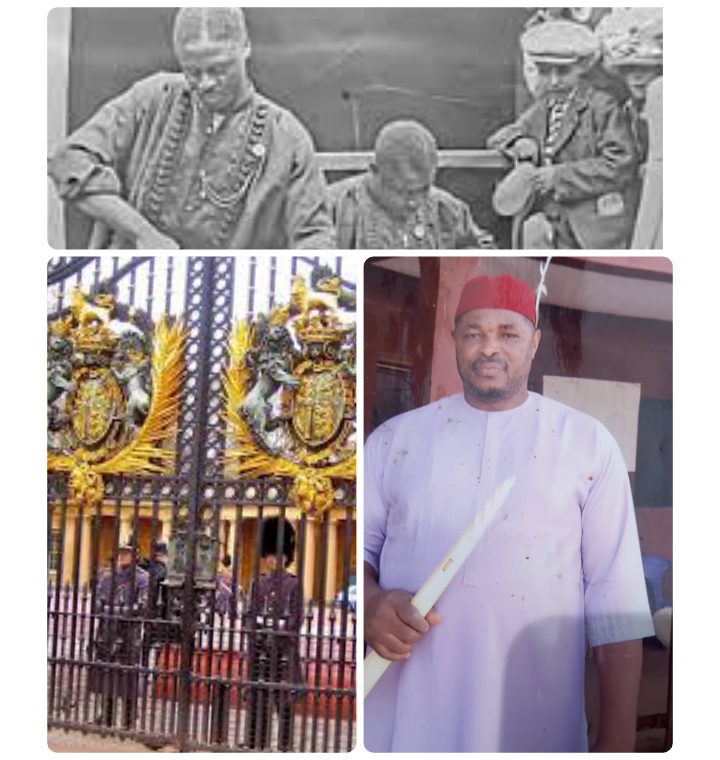
Buckingham Palace gates
By Chikason Ikeli, Awka
A community leader in Awka, Anambra State, Chief Tochukwu Nwokoye Nwosu, has commended the remarkable technological achievements of the Awka people.
He specifically celebrated two of Awka’s sons Sir David Agbata Nwume of Umuonaga and his compatriot, Sir John Uzoka of Umuogbu, both from Agulu-Awka for their role in manufacturing the gates of Buckingham Palace, located within the Borough of Westminster, London, England.
Nwokoye stated that the duo, Nwume and Uzoka, were discovered in 1905 by the then Principal of St. Paul’s College, Awka, Rev. George Basden, who recommended them to participate in an exhibition in Wembley, London.
With pride, he recounted that his kinsmen participated in the London Exhibition and contributed to the production of the Buckingham Palace gates a project originally commissioned to the Bromsgrove Guild of Applied Arts for design.
According to Nwokoye, Uzoka died in 1938, ten years after Nwume’s death. Both men were recognized and honored with the British Empire’s highest award, the Member of the British Empire (MBE).
He called for the revival of Awka blacksmithing, which he noted was historically the major means of livelihood for the people of Awka.
However, he lamented the decline in the number of celebrants of the Ukwu Feast, attributing it to what he described as a conspiracy aimed at discouraging production and cutting off the supply of guns, weapons, and ammunition in Awka and, more broadly, Igboland.
Speaking on this development, the Chairman of the Odumma Awka General Assembly, Akajiofo Tochukwu Nwokoye Nwosu, observed that there is currently a dearth of traveling blacksmiths.
This shortage has adversely affected their general return and, consequently, the celebration of the Ukwu Feast,a traditional event held to thank and honor the Ukwu god and ancestors for journey mercies.
Nwokoye further lamented that the decline in Ukwu Feast celebrations was fueled by “undercover” politics aimed at suppressing Awka blacksmiths and Igbo technological ingenuity. This was driven by fear that Awka blacksmithing could serve as the production and supply base for the Ogbunigwe the “mass killer” bomb used by Biafrans during the 1967–1970 Nigeria-Biafra War.
He also asserted that the international community was uneasy about the Ndigbo people, fearing they could emerge as a black superpower in Africa through their blacksmithing skills and the potency of the Ogbunigwe weapon.
According to Nwokoye, Awka made an indelible mark on the sands of time through its technological achievements. As he reiterated, both Sir David Agbata Nwume of Umuonaga and Sir John Uzoka of Umuogbu were celebrated for their work on the Buckingham Palace gates in London.
He highlighted again that the duo was discovered in 1905 by Rev. George Basden, who recommended their participation in the Wembley exhibition. He contended that their craftsmanship contributed to the production of the Buckingham Palace gates, a project initially designed by the Bromsgrove Guild of Applied Arts.
Uzoka died in 1938, ten years after Nwume, and both men received the prestigious Member of the British Empire (MBE) award in recognition of their achievements.
Finally, Nwokoye urged a revival of blacksmithing in Awka, emphasizing its historical importance as the primary livelihood of the Awka people.