



We’re Sorry for Holy See’s Role in Legitimising Slavery, Pope Apologises
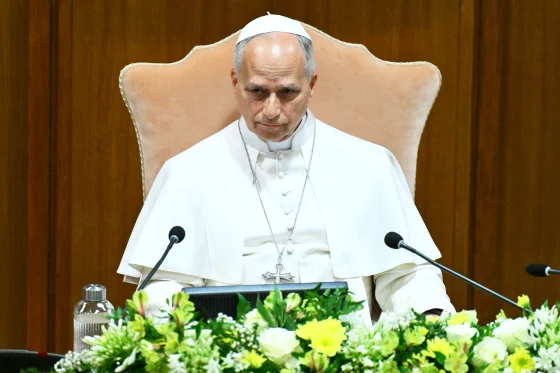
Pope Leo XIV
The Catholic pontiff, Pope Leo XIV, on Monday issued a historic apology for the role the Holy See played in legitimising slavery and for the Church’s failure to condemn the practice for centuries.
According to the Pope, the Vatican’s record on slavery remains “a wound in Christian memory.”
While previous popes had apologised for Christians’ involvement in the trans-Atlantic slave trade, no pope had ever publicly acknowledged, much less apologised for the role past popes themselves played in granting European sovereigns explicit authority to subjugate and enslave “infidels.”
History’s first US-born pope, whose family history reportedly includes both enslaved people and slave owners, delivered the apology in his first encyclical, Magnifica Humanitas (“Magnificent Humanity”), which was released yesterday, NBC News reports.
The sweeping manifesto focuses on safeguarding humanity in an era of increasing dependence on artificial intelligence.
Pope Leo XIV referenced the trans-Atlantic slave trade while discussing what he described as new forms of slavery and colonialism being fuelled by the digital revolution, including the unregulated labour involved in the extraction of rare minerals used in the production of AI chips.
In doing so, the Pope responded to decades of calls from Black American Catholics, activists, and scholars urging the Holy See to atone for its role in the colonial-era trade in human beings.
“It is impossible not to feel deep sorrow when contemplating the immense suffering and humiliation endured by so many, in stark contrast to their immeasurable dignity as persons infinitely loved by the Lord,” Leo wrote. “For this, in the name of the Church, I sincerely ask for pardon.”
The Vatican has long maintained that it upheld the dignity of all human beings as children of God. However, a series of 15th-century papal directives authorised Portuguese sovereigns to conquer territories in Africa and the Americas and enslave non-Christians.
In 1452, for example, Pope Nicholas V issued the papal bull Dum Diversas, which granted the Portuguese king and his successors the authority “to invade, conquer, fight and subjugate” and seize all possessions ,including land — belonging to “Saracens, pagans, and other infidels, and enemies of the name of Christ.”
The decree also permitted the Portuguese “to reduce their persons to perpetual slavery.”
That bull, alongside another issued three years later, Romanus Pontifex, formed the basis of the Doctrine of Discovery — the theory used to legitimise the colonial-era seizure of lands in Africa and the Americas.
According to the Rev. Christopher J. Kellerman, a Jesuit priest and author of All Oppression Shall Cease: A History of Slavery, Abolitionism, and the Catholic Church, Pope Nicholas V’s permissions to the Portuguese were later confirmed or renewed by Pope Callixtus III in 1456, Pope Sixtus IV in 1481, and Pope Leo X in 1514.
Spanish monarchs were subsequently granted similar rights over territories in the Americas.
Although the Vatican formally repudiated the Doctrine of Discovery in 2023, it has never formally rescinded, abrogated, or rejected the papal bulls themselves.
The Vatican argues that a later papal bull, Sublimis Deus, issued in 1537, reaffirmed that Indigenous peoples should neither be deprived of their liberty and property nor subjected to enslavement.