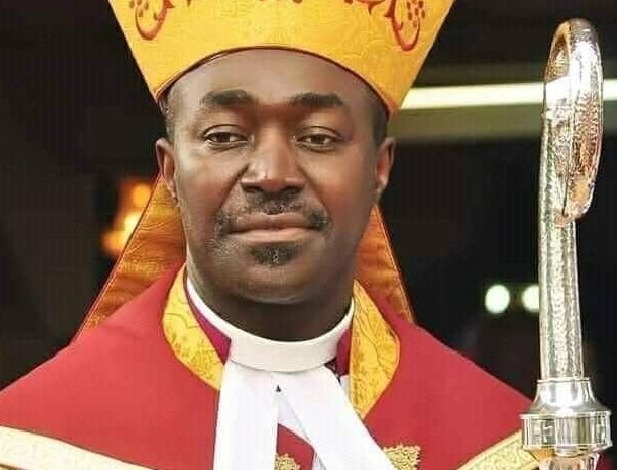




Anambra Activist Obi, Others Drag Awka Catholic Diocese to Court over Alleged Fraudulent Judgment
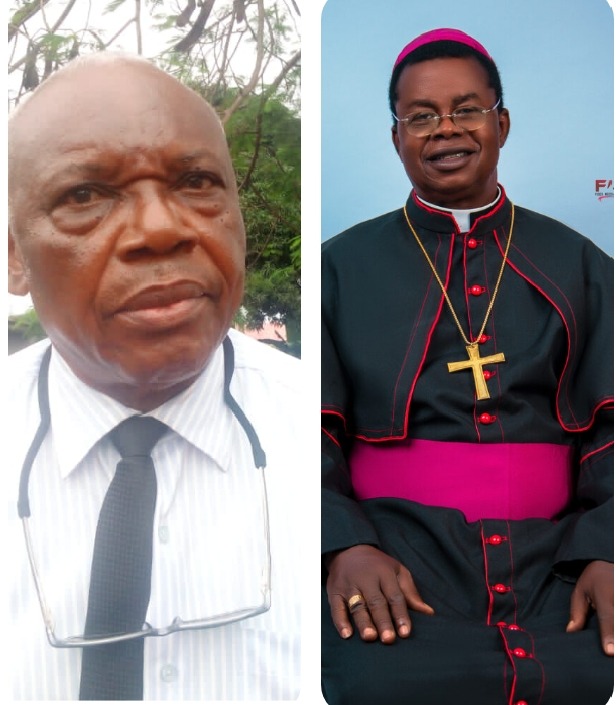
Human Rights Activist,Comrade Osita Obi and the Catholic Bishop of Awka Diocese, Most Rev. Dr. Paulinus Ezeokafor.
By Titus Eleweke
An Anambra-based human rights activist, Comrade Osita Obi, has dragged the Catholic Diocese of Awka and Rev. Fr. Chudy Aguinam before Magistrate Court 4, sitting in Amawbia, Awka South Local Government Area of Anambra State, over what he described as the fraudulent procurement of a court judgment .
The matter, presided over by Her Worship E. C. Chukwu, is contained in a suit marked MAW/1075/2025, between Mr. Chidi Osakwe and six others as plaintiffs and the Catholic Diocese of Awka and another party as defendants.
Through his counsel, Mr. Martins Obi (Esq.), the activist is seeking, among other reliefs, an order setting aside an earlier judgment allegedly obtained fraudulently by the Catholic Diocese of Awka against his clients.
When the matter came up for hearing on Thursday, October 15, 2026, counsel to the plaintiffs, Martins Obi, urged the court to set aside the judgment, which he alleged had been obtained through the “backdoor.”
Addressing the court, the lawyer said the dispute arose from an earlier criminal suit instituted by the Catholic Diocese of Awka against his clients, whom the diocese allegedly described as unknown persons.
“Her Worship, what brought about this suit is that the Catholic Diocese of Awka had filed a criminal suit in this court against my clients, Osita Obi and others, whom they described as unknown persons.
“They filed a case in this court and claimed that they had served my clients with the necessary court processes.
“Based on that deception, this court proceeded to hear the case and delivered judgment in their favour. In the process of executing the judgment, the diocese broke into the apartments occupied by my clients, comprising about 10 different tenants, and threw their belongings outside in the rain,” he alleged.
According to the lawyer, his clients only became aware of the earlier suit and the judgment against them when the diocese moved to enforce the court’s decision.
He said they subsequently approached the court to obtain the relevant documents relating to the judgment and, after examining them, discovered what he described as irregularities in the proceedings.
“This is why they filed this suit to tell the court that the judgment was obtained by fraud,” he said.
Obi further alleged that one of the grounds of the suit was that the persons described by the diocese as unknown were, in fact, known to it.
“One of the grounds for this suit is that the persons they described as unknown are actually known to them. So, for them to say that they were dealing with unknown persons was a lie from the pit of hell, because there is evidence to prove that they knew the tenants,” he alleged.
He said the plaintiffs intended to establish that the procedure adopted by the diocese in obtaining the earlier judgment against them was fraudulent and that the judgment should consequently be set aside.
Citing Section 6(6)(a) and (b) of the 1999 Constitution of the Federal Republic of Nigeria, as amended, alongside common law principles and established judicial precedents, the plaintiffs’ counsel argued that courts of record possess inherent judicial powers to ensure justice.
He maintained that such powers include the authority to nullify or set aside a judgment where it is established that the judgment is a nullity or was procured through fraud.
Reacting, counsel to the defendants, J. A. Obiajulu (Esq.), informed the court that he had filed a preliminary objection challenging its jurisdiction to entertain the suit.
Citing Section 272(1) of the 1999 Constitution of the Federal Republic of Nigeria, as amended, Obiajulu argued that matters relating to land ownership and title fall within the jurisdiction of a State High Court.
He contended that the plaintiffs’ suit bordered on the ownership of property and that the Magistrate Court lacked the requisite jurisdiction to entertain it.
In his response, Martins Obi acknowledged that a Magistrate Court does not have the inherent power to determine disputes over ownership or title to property.
However, he argued that the suit he instituted on behalf of his clients was not concerned with determining who owned the property.
Rather, he said, the purpose of the suit was to establish how the earlier judgment was obtained against his clients and to demonstrate that it was allegedly procured through fraudulent means.
He maintained that the plaintiffs were asking the court to set aside the earlier judgment on the grounds of fraud, as well as nullify its execution against them.
The lawyer further argued that although a Magistrate Court was restricted from entertaining suits concerning ownership or title to land, it had jurisdiction to hear recovery-of-premises and landlord-and-tenant matters.
After listening to the arguments of counsel, Magistrate E. C. Chukwu adjourned the matter to November 26, 2026, for continue hearing.
Speaking with journalists after the court proceedings, one of the plaintiffs, Comrade Osita Obi, alleged that the dispute arose after his wife retired and rented a shop in Awka to engage in business.
He claimed that agents of the Catholic Diocese of Awka subsequently broke into the shop and threw his wife’s goods outside in the rain.
According to Obi, those who carried out the enforcement claimed to have obtained a court judgment against his wife, despite allegedly failing to serve her with the court processes that led to the judgment.
He accused the diocese of portraying his wife as a criminal and subjecting her to public humiliation.
Obi vowed to pursue the case to its logical conclusion, insisting that the circumstances surrounding the earlier judgment and its enforcement must be properly examined by the court.