




Disquiet at Ojukwu University over Selection of Prof. Kate Azuka Omenugha as Substantive Vice Chancellor

There is growing disquiet and apprehension at Chukwuemeka Odumegwu Ojukwu University (COOU) regarding the selection of Prof. Kate Azuka Omenugha as the substantive Vice Chancellor of the institution.
Critics have compared this selection to the controversial governorship election in Imo State, where a candidate who ranked fifth emerged as governor. According to documents obtained by our correspondent, Prof. Kate Azuka Omenugha, a professor of Mass Communication at Nnamdi Azikiwe University, Awka, ranked fifth in the interview process conducted by the joint committee of the university council and senate.
The documents reveal that Prof. Kate Azuka Omenugha scored 73 percent, placing fifth, after a peaceful and transparent interview process. The rankings were as follows:
Prof. Chike Osegbue – 83% (1st position)
Prof. Leonard Onuba – 81% (2nd position)
Prof. Chukwudi Onyeaghana – 78% (3rd position)
Prof. Nnama Umenweke – 75% (4th position)
Prof. Kate Azuka Omenugha – 73% (5th position)
Some stakeholders within the university questioned the integrity of the interview process, suggesting that the appointment of Prof. Omenugha was predetermined. They argued that conducting the interview was a mere formality and a waste of time and resources.
In a document titled COOU’s Vice Chancellor Selection: A Test of Law, Integrity, and Institutional Honour, it was stated that what began on 18 December 2024 as a flawed senate election committee exercise to select three representatives for the joint council/senate committee has now become a critical test of the university’s commitment to law and integrity.
The initial flawed process, conducted under acting Vice Chancellor Prof. Kate Azuka Omenugha, was annulled following intervention by the Visitor of the university, the Governor of Anambra State, Prof. Charles Chukwuma Soludo.
A fresh election was conducted on 9 July 2025, closely monitored by the Honourable Commissioner for Education, Dr. Ngozi Chum-Udeh, who restored credibility to the process. This was followed by interviews of shortlisted candidates on 30–31 July by a seven-member selection committee. The three candidates who emerged as the top-ranked in order of merit were:
Prof. Chike Osegbue – 83%
Prof. Leonard Onuba – 81%
Prof. Chukwudi Onyeaghana – 81%
The document emphasized that the university is governed by the COOU Law of 2014, along with the university’s statutes and ordinances. Under this law, the Visitor (the state governor) is the appointing authority. Ordinance 11(4)(d) of the COOU Law requires the Visitor to appoint the Vice Chancellor from a list of three candidates recommended by the council, in their order of merit. The council is also mandated to justify the order of merit in its recommendation.
It is publicly known that the report submitted to the Visitor on 1 August following the 30–31 July interviews included the names of the top three candidates ranked in order of merit, along with detailed justifications.
Meanwhile,the Visitor, in a letter addressed to the Pro-Chancellor and Chairman of Council, commended the council for the rigorous and transparent process.
However, the letter signed by the Secretary to the State Government (SSG), Prof. Solo Chukwulobelu, conveyed the Visitor’s approval of the appointment of the acting Vice Chancellor, Prof. Kate Azuka Omenugha,who ranked fifth with 73 percent as substantive Vice Chancellor, citing benchmarks that are inconsistent with the COOU Law of 2014.
The document describes this as a staggering violation of university law that compromises a process which, for the first time in the university’s 25-year history, had been rigorous, transparent, credible, and fair. The announcement of Prof. Omenugha’s appointment has sparked mourning and public outcry within the university community, among staff and students, who reject what they perceive as an imposed candidate not statutorily presented to the Visitor.
This gross and flagrant abuse of the COOU Law threatens the institution’s core value of meritocracy. The university’s reputation as a credible center of learning has been set back by a decade. The incursion of political interference could jeopardize the institution’s future.
Furthermore, the appointment violates not only the university law but also the 2014 visitation panel report, which insisted that all organs involved in appointing the Vice Chancellor must fully comply with statutory provisions to confer legitimacy on the appointee. Consequently, the individual announced as Vice Chancellor lacks both authority and legitimacy.
The university community collectively rejects this flagrant abuse of COOU law and calls on the Visitor to uphold merit by appointing the top-ranked candidate, in accordance with the university statutes and principles of fairness.
The statement firmly declares: We shall not accept the imposition of a candidate who placed fifth in a process adjudged transparent and credible. The community is urged to resist this imposition for the sake of the university, its staff, students, and the public. The COOU law is clear; the process was transparent and fair. Merit has spoken. It is time to listen.
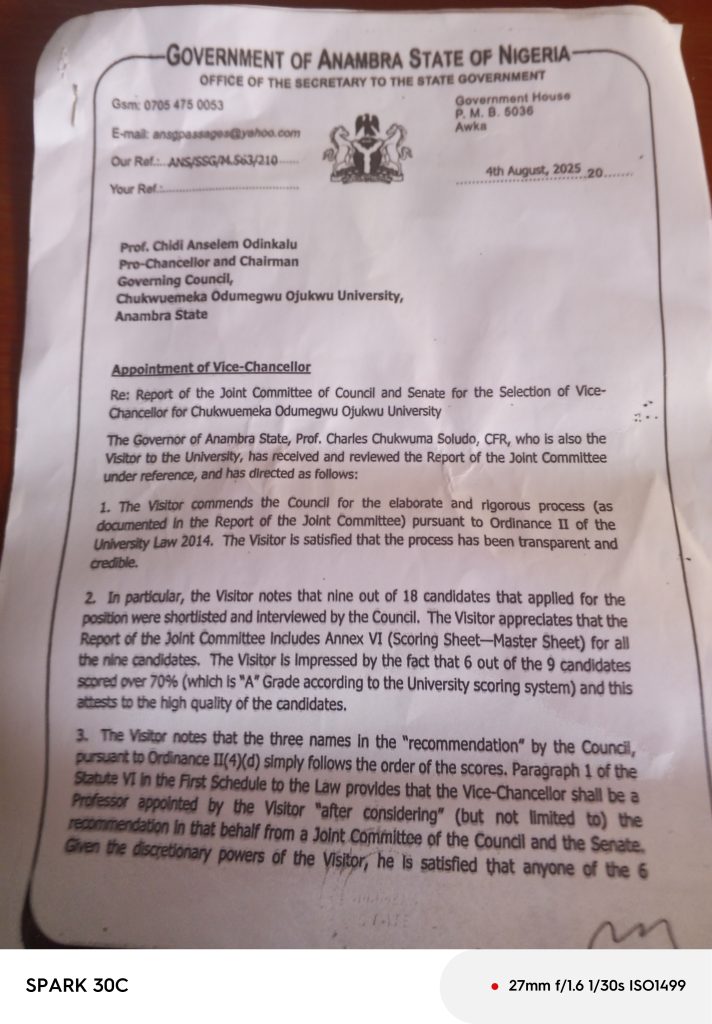
In a letter from the Government of Anambra to the Pro-Chancellor and Chairman of the Governing Council, Prof. Chidi Anselm Odinkalu, signed by the Secretary to the State Government, Prof. Solo Chukwulobelu, conveying the appointment of Prof. Kate Azuka Omenugha as substantive Vice Chancellor, the following was stated:
The Visitor commended the council for the elaborate and rigorous process (as documented in the report of the Joint Committee) pursuant to Ordinance 11 of the University Law of 2014. The Visitor is satisfied that the process was transparent and credible.
In particular, the Visitor noted that nine of eighteen candidates who applied were shortlisted and interviewed by the council. The report of the Joint Committee included a scoring sheet for all nine candidates. Impressively, six candidates scored over 70 percent, classified as an “A” grade according to the university’s scoring system, attesting to the high quality of the candidates.
The Visitor further observed that the three names recommended by the council pursuant to Ordinance 11(4) followed the order of merit.
Paragraph 1 of Statute VI of the first schedule to the law provides that the Vice Chancellor shall be a professor appointed by the Visitor “after considering”—but not limited to—the recommendations of the joint council and senate committee.
Given the discretionary powers of the Visitor, he is satisfied that any one of the six candidates with an “A” grade has the competence and qualifications to perform the job.
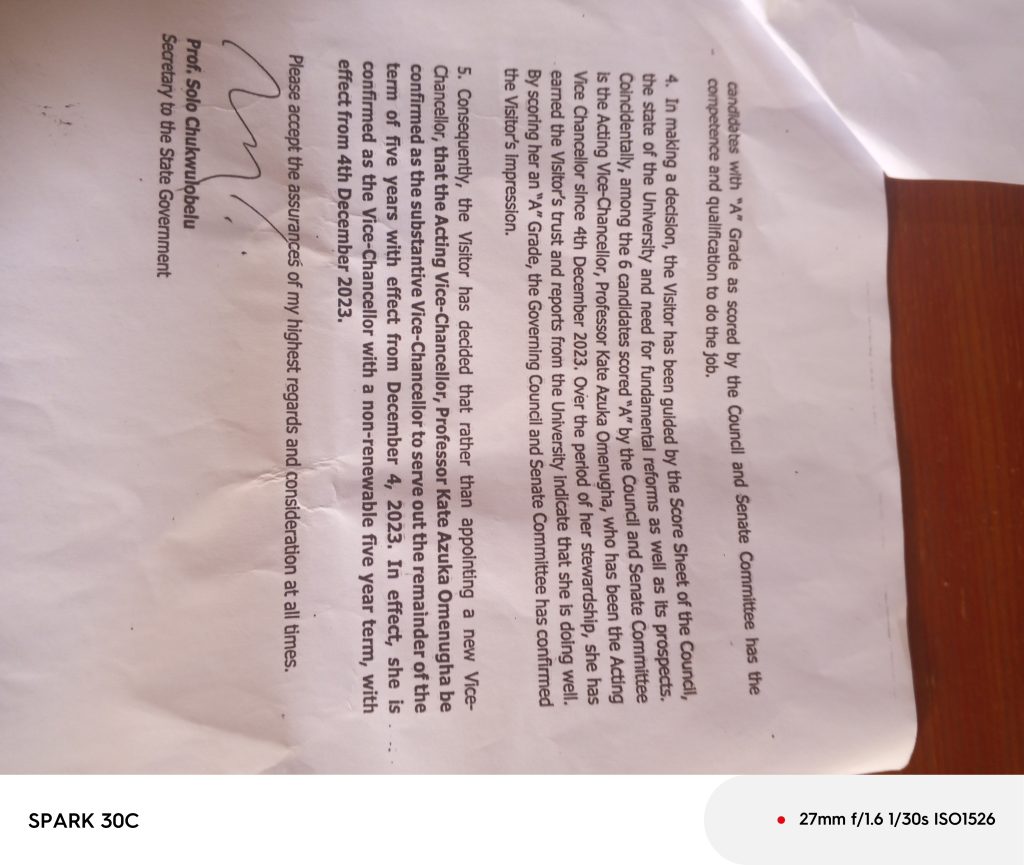
In making his decision, the Visitor considered the council’s score sheet, the state of the university, the need for fundamental reform, and its future prospects.
Among the six candidates with an “A” grade is the acting Vice Chancellor, Prof. Kate Azuka Omenugha, who has served since 4 December 2023. Over her tenure, she has earned the Visitor’s trust, with reports indicating satisfactory performance.
By awarding her an “A” grade, the governing council and senate committee have confirmed the Visitor’s positive impression.
Consequently, the Visitor decided that rather than appointing a new Vice Chancellor, the acting Vice Chancellor, Prof. Kate Azuka Omenugha, should be confirmed as substantive Vice Chancellor to serve the remainder of the five-year term,non-renewable with effect from 4 December 2023.
Given the tension and apprehension in the university, and even with the Visitor’s decision, the battle for the Vice Chancellor position at Chukwuemeka Odumegwu Ojukwu University appears far from over. Information available to us indicates that some groups and individuals may soon approach the courts to challenge the appointment.