Umahi Attack: Governor Makinde’s Search for Relevance
By Emmanuel Uzor
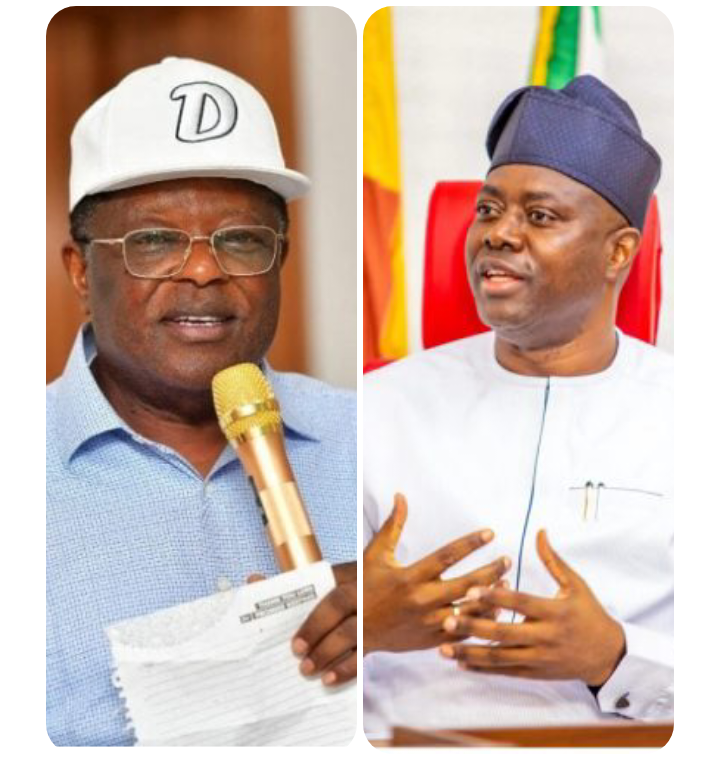
Even if every Nigerian,Tom, Dick, and Harry feels compelled to speak, albeit within the limits of their understanding, Governor Seyi Makinde remains one of the least qualified to use the name of the Honourable Minister of Works, Senator David Umahi, as a springboard for political relevance.
A recent video clip shows Governor Makinde, cloaked in the failures of leadership and wasted public confidence, invoking Umahi’s name not for constructive dialogue, but seemingly to score cheap political points. It’s unfortunate that a two-term governor of a historically significant state like Oyo would resort to such antics, especially when his own record on infrastructure leaves so much to be desired.
Let’s be clear, in terms of infrastructure development, especially road construction, Makinde is in no position to throw stones. The people of Ibadan—the ancient capital of Oyo State are still battling deplorable road conditions. If the state capital is in this state of disrepair, one can only imagine the conditions in rural areas. So when Makinde attempts to ridicule Umahi, what he’s truly doing is highlighting his own failures.
Makinde’s attempt to mock Senator Umahi during his commentary on Arise TV, particularly regarding the Coastal Highway backfired embarrassingly.
He claimed that the proper question should have been about the “average cost per kilometre” rather than simply “cost per kilometre,” as if this rhetorical twist somehow invalidated the project or the Minister’s competence.
For the record, Senator Umahi proactively appeared on Arise TV not under duress, not in defense, but to provide transparency. He explained in detail the bidding process, the cost structure, and the logic behind the project from its conceptualization to its current phase. He has, in fact, conducted numerous town hall meetings with stakeholders across the zones affected by the project making the process one of the most transparent infrastructure undertakings in recent Nigerian history.
Moreover, the extension of the Coastal Highway by an additional 100 kilometers at the Edo State axis naturally alters the total cost and affects cost per kilometre calculations.
This is not deceit; it’s basic project management. It is unfortunate that even a governor like Makinde fails or refuses to grasp this elementary fact, choosing instead to align with uninformed critics like Rufai Oseni, who was publicly educated by Umahi during the same interview.
Makinde’s commentary is not just misinformed ,it reeks of envy and political desperation. A man who has failed to deliver on key sectors in his state should be more circumspect before launching rhetorical attacks against a peer whose legacy in Ebonyi State is undeniable.
As governor, Umahi transformed one of Nigeria’s poorest states into a hub of infrastructural development within eight years. His achievements in road construction, urban renewal, and economic infrastructure are not theoretical—they are physical, measurable, and enduring.
It is ironic that Makinde, in his confused political odyssey,sometimes sounding like a presidential hopeful, other times a regional opposition leader is attempting to reinvent himself at the expense of others. But here’s a simple truth: a man who betrays his own cannot be trusted by outsiders. Playing politics with a national project as important as the Coastal Highway is not only short-sighted it is dangerous.
What should be a shared national responsibility is now being dragged through the mud by those seeking attention rather than contributing to progress.
The majority of Nigerians, contrary to Makinde’s insinuations, are satisfied with the process and pace of the Coastal Highway project. The Honourable Minister has not only shown capacity but has carried the people along every step of the way.
Even some of the project’s early critics have since recanted. But now, anyone with access to data and social media joins the bandwagon of noise-makers shouting, “What is the cost per kilometre?” often without the faintest understanding of the subject matter. It’s become a free-for-all chorus of ignorance, enabled by political opportunists.
In conclusion, the people of Oyo State deserve more than a governor who behaves like a content creator seeking online validation. Leadership requires vision, discipline, and delivery—not grandstanding or contradictions. Governor Makinde appears to be campaigning for every office at once—President, Vice President, and Senator—without offering concrete value in his current role.
Let him return to the business of governance, deliver real dividends of democracy to his people, and leave the political dance in the marketplace to those who have nothing to lose. Umahi remains a “big masquerade” in the realm of infrastructure and national development. Instead of joining the “data boys” and media activists, Makinde should align with other responsible leaders who appreciate the wisdom of President Bola Ahmed Tinubu in appointing a performer like Umahi.
There are no questions surrounding Umahi’s competence—only political envy. And that, unfortunately, is what Makinde has chosen to peddle.
Emmanuel Uzor is a public affairs analyst. He writes from Awka, Anambra State