


A Light in the Capital: What Light House Awka Really Says About Anambra’s New Ambition
Titus Eleweke
For more than three decades, Anambra lived with a quiet contradiction: a state famed for enterprise and intellect, yet governed from a structure never meant to endure. The so-called Government House,originally a prefabricated shelter for construction workers,stood as a metaphor for deferred seriousness. Four administrations passed through it,Mbadinuju, Ngige, Obi, Obiano,each inheriting the same improvised seat of power, each leaving it unresolved.
That history matters, because what Professor Charles Soludo has done is not just to build,it is to break a pattern.
Arriving in 2022, Soludo did not disguise the problem. He named it bluntly: a decades-long embarrassment. But more importantly, he chose not to treat it with the familiar Nigerian instinct for cosmetic fixes. Instead, his administration undertook something more deliberate and more symbolic,a complete reimagination of the seat of governance.
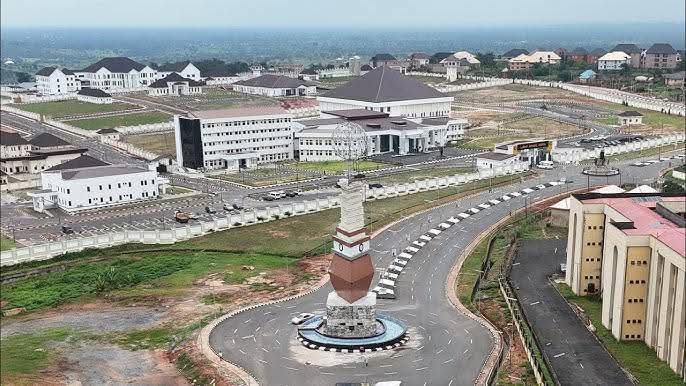
Light House Awka is not merely a Government House. It is a statement. A twenty-three-hectare campus of more than fifty structures, built only after stabilizing land ravaged by gully erosion, it reflects planning before prestige. Its components,the Executive Council Chambers, a 1,225-seat banquet hall, an amphitheatre, the Light of the Nation Tower,signal an attempt to embed governance within an ecosystem, not a compound.
President Bola Tinubu’s declaration at its commissioning,“Anambra is rising”,may sound like ceremonial optimism. But in this case, it captures something real: the project represents a shift in what state governments believe is possible to execute within Nigeria’s constraints.
Yet, the deeper significance of Light House Awka lies beyond architecture.
It sits within a broader governing philosophy that has, by official figures, delivered over 900 kilometres of roads, multiple bridges, new hospitals, and thousands of recruited teachers,all reportedly without resorting to commercial borrowing. Whether one agrees with every policy choice or not, the pattern is unmistakable: a preference for visible, countable outcomes over rhetorical governance.
Still, it would be a mistake to romanticize concrete.
Nigeria has never suffered from a shortage of impressive structures. What it has often lacked is institutional consistency,systems that outlive the administrations that build them. The real test of Light House Awka, therefore, is not how it looks today, but what it enables tomorrow. Will it become a hub of efficient decision-making, or simply another well-photographed address? Will it deepen public trust, or stand apart from the citizens it is meant to serve?
Because governance is not measured by edifices alone. It is measured by whether those edifices translate into better schools that function, hospitals that heal, roads that endure, and institutions that behave predictably.
Light House Awka raises the bar,but it also raises expectations.
And that may be its most important contribution. By choosing ambition over improvisation, Anambra has altered the conversation. It has suggested that subnational governments in Nigeria do not have to be defined by limitation. That planning, scale, and execution can coexist. That public projects can aspire to permanence, not patchwork.
But ambition, once demonstrated, becomes a burden.
The light Anambra now claims is not decorative. It is a demand,for continuity, for discipline, and for governance that remains as intentional as the structure that now houses it.
The state has built something worthy of attention. The harder task begins now: proving it is worthy of trust.