

Imo Agric University Unveils Climate-Smart Tools to Boost Research, Food Security
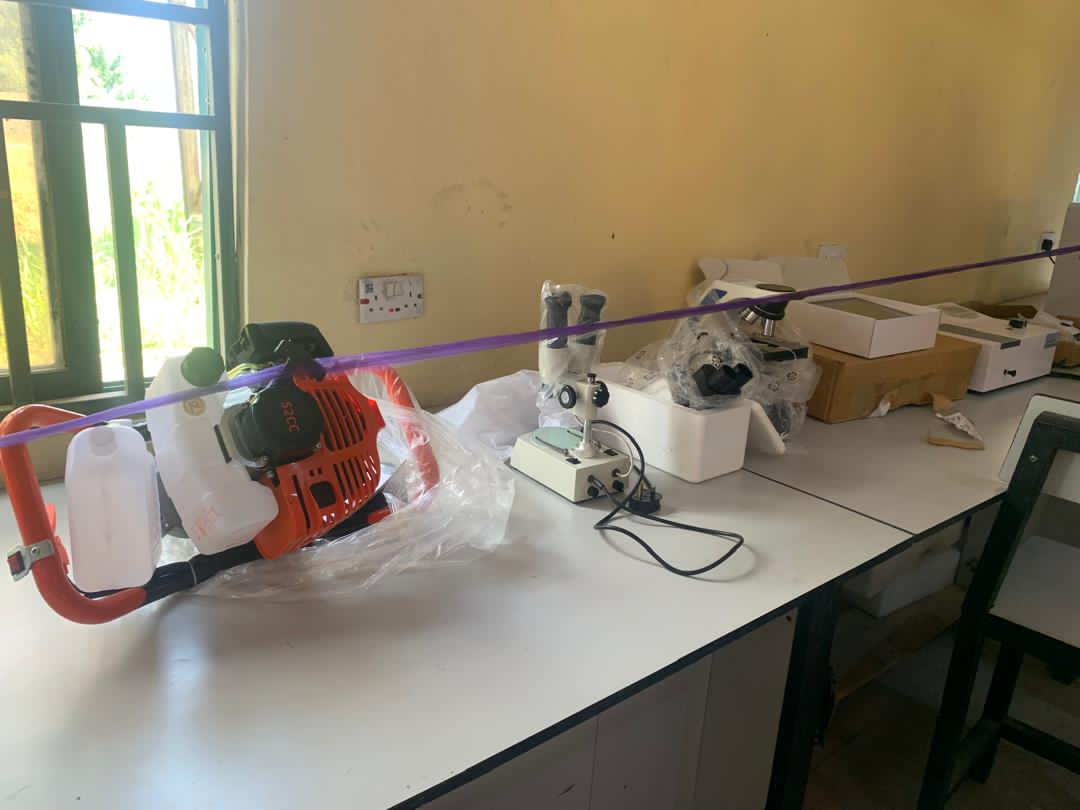
The University of Agriculture and Environmental Sciences (UAES), Umuagwo, Imo State, has unveiled European Union (EU)-funded climate-smart tools valued at millions of naira, aimed at strengthening agricultural research and enhancing food security in Nigeria.
The Vice-Chancellor of the university, Prof. Christopher Eze, unveiled the equipment during a one-day Agro-ecology Info Day workshop held on Friday at the Umuagwo campus, near Owerri.
Eze said the launch of the high-tech laboratory, which includes drones and soil-testing equipment, was designed to equip rural farmers and researchers with sustainable and climate-resilient farming techniques.
The equipment includes compound and dissecting microscopes, a spectrometer, blood analyser, Global Positioning System (GPS) device, soil auger, chlorophyll meter, Munsell colour chart, and an 86-inch UHD 4K smart board, among others.
“Today represents a strong intersection of knowledge, partnership, and innovation,” Eze said.
He explained that the ERASMUS+ European Union investment had transformed the institution into a key regional innovation hub.
“The laboratory will support our new MSc programme in Agro-ecology, providing the infrastructure needed for hands-on training and the transfer of critical scientific knowledge to local farming communities,” he added.
Beyond the provision of equipment, Eze disclosed that the university had introduced a digital marketing application aimed at eliminating middlemen and protecting farmers from inflation by linking them directly with global consumers.
The vice-chancellor stressed the need for Nigeria to move beyond “food sufficiency” to “food sovereignty,” noting that the latter would ensure national control over agricultural production and seed systems.
“To sustain this growth, the Federal Government should provide subsidies and mandate the Bank of Agriculture to offer loans at interest rates below 10 per cent, without rigid collateral requirements.
“Our focus should be on how we can attain food sovereignty,” he said.
Eze further emphasised that national security must be guaranteed to enable farmers to safely adopt new technologies and contribute effectively to feeding the nation.
He also challenged the National Assembly to prioritise legislation on the “right to food” as a critical national security measure, particularly to protect citizens and farmers during economic crises.
According to him, achieving food sufficiency would require policies that include subsidies for food production.
He commended the ERASMUS+ EU programme for its strategic investment in the institution and the future of agriculture in Nigeria.
In an interview, the Coordinator of the university’s AGRICO Farm Project MSc programme, Dr Ayo Enwerem, said the workshop was organised to showcase the impact of the ERASMUS+ EU project in promoting agricultural research and food security among rural farmers.
“Our goal is to build farmers’ capacity in agro-ecology and climate-smart agricultural practices to improve food production and help them cope with the impacts of climate change,” he said.
Enwerem expressed confidence that the workshop would enhance farmers’ yields and expose MSc students of Agro-ecology to the use of modern agricultural equipment.
The workshop brought together farmers’ groups, students, lecturers, and other key stakeholders.
It also featured paper presentations, including “Reclamation and Maintenance of Soil Fertility in a Continuous Cropping System” by Dr Adaobi Onyechere, and “The Use of Certified Seeds and Inputs as a Panacea for Increased Crop Yield” by Dr Angus Ikeh.
Other presentations included “Impact of Women in Agriculture on Food Security” by Dr Alice Amanze, and “Climate-Smart Agricultural Practices to Mitigate the Effects of Climate Change on Farm Operations” by Dr Leonard Amulu.