
We Are Truly Inspired: Teachers Reflect on the Impact of GRENCHI’s Climate Boot Camp
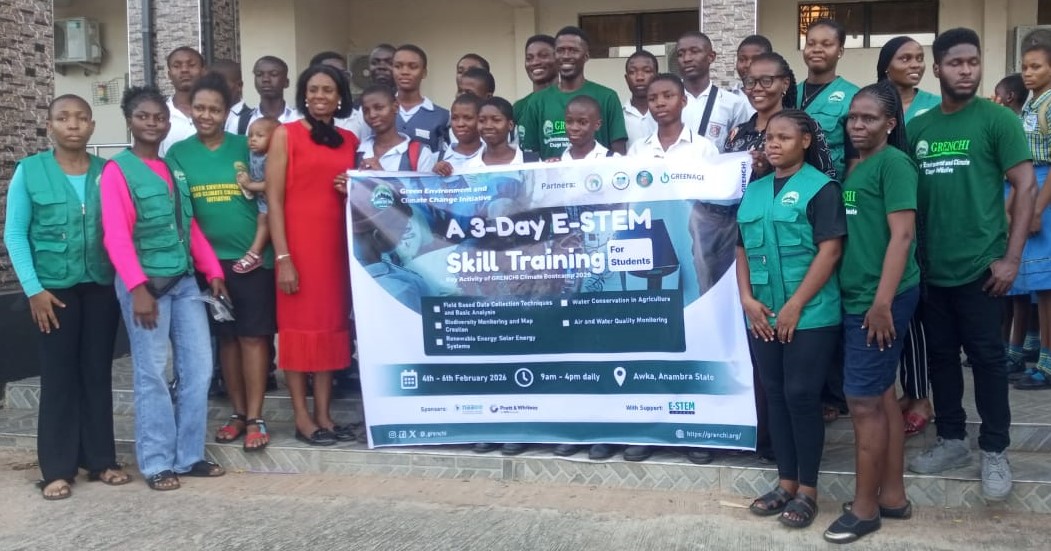
For three transformative days, teachers watched their students step beyond the confines of textbooks and engage directly with real-world climate solutions.
They saw fear give way to curiosity at the zoo. They watched confusion turn into clarity as students connected solar panels. They observed abstract theories take on practical meaning during hands-on agricultural training.
For the teachers who accompanied their students to the E-STEM Climate Boot Camp organised by the Green Environment and Climate Change Initiative (GRENCHI), the experience was not merely educational it was deeply inspiring and transformative.
Mrs. Stella Anayo of Community Secondary School (CSS), Enugwu-Agidi, expressed heartfelt appreciation as she reflected on the programme.
“It has been a wonderful experience. The NGO did very well by bringing us here,” she said.
According to her, the biodiversity session on the first day stood out for its depth, structure and level of engagement. Students were introduced to various species of birds, plants and animals, and were even guided on how to identify certain trees using their scientific names.
“It was very engaging and interactive,” she noted.
He emphasized how enthusiastically the students participated.
The agricultural training left an equally strong impression. Students were taught practical planting techniques including how to properly water maize seeds before planting and how to treat yam setts before placing them in the soil to ensure healthy growth.
“They were genuinely excited to learn techniques they could apply themselves,” she said.
For Mrs. Anayo, the excursion to the zoo was one of the most memorable highlights of the boot camp. Many of her students were seeing a lion for the first time in their lives.
“They said it was the first time they had ever seen a live lion. It was very exciting,” “We also saw several other animals, including large snakes.”
She admitted that even she learned something new during the visit.
“The handler held one of the snakes and explained that it was non-venomous — that it relies on strength to constrict its prey rather than poison. I didn’t even know that some snakes do not have venom,” she said.
Beyond the excitement, the visit deepened students’ understanding of wildlife conservation and biodiversity.
On the final day, the training shifted toward technical skill-building. Students were introduced to basic map-reading calculations and the fundamentals of solar panel installation. Rather than simply observing demonstrations, they actively participated in assembling and connecting components.
Mrs. Anayo expressed confidence that the lessons learned would extend far beyond the camp.
“We have already made plans for when we return to school,” “We intend to request a portion of land to establish a crop garden and orchard based on what we learned during the agricultural sessions.”she explained.
She added that students who demonstrated strong understanding during the solar training would attempt to replicate a small-scale installation at school.
“Even if it is only to create a charging point for teachers’ phones, we will start from there. What matters is that we put the knowledge into practice. We are determined that what they have learned will not fade away.”he said.
Mrs. Chidubem Okafor, a club facilitator from Capital City Secondary School, Awka, also described herself as highly impressed by the organisation and relevance of the programme.
“A great deal has been learned here,” she said.
According to her, the boot camp was carefully structured around three key thematic areas: water conservation in agriculture, renewable energy, and biodiversity conservation all of which she described as critical in today’s climate realities.
She particularly emphasised the importance of innovative water conservation methods such as hydroponics and vertical farming. With land degradation and water scarcity becoming more pronounced due to climate change, she noted that such approaches offer sustainable alternatives for food production.
“If we embrace these concepts, we can significantly increase food supply even with limited resources,”
On renewable energy, she described the training as a potential game-changer for young people.
“The young ones have the energy and enthusiasm, while we have experience and guidance to offer. If we collaborate effectively, we can achieve meaningful and lasting results,” she said.
Despite her optimism, Mrs. Okafor called for greater government and institutional support to expand initiatives like the boot camp. She lamented that only 15 students from her school which has thousands of learners — were able to participate.
“Such exposure changes mindsets. It prepares students not just academically, but for the future,” “Many more students deserve this opportunity.”
She captured her hope in a powerful metaphor:
“It is not only about planting trees; it is also about planting knowledge in children. When you plant knowledge, it grows, takes root, and blossoms like an oak tree.”she said.
Benefits for Both Students and Teachers
Similarly, Anulika Nwabude of Nwafor Orizu Demonstration Secondary School, Awka, described the programme as “wonderful,” noting that both students and teachers gained valuable insights.
“The students learned a great deal, particularly highlighting the renewable energy session where participants practiced installing and connecting solar panels. “We watched them attempt the connections themselves.” she said.
She added that students involved in biodiversity conservation engaged in map-reading and environmental calculations, while those in the water conservation track gained hands-on agricultural experience.
The zoo excursion, she noted, was equally enlightening for teachers.
“I sincerely thank the organisers, GRENCHI, for putting this together,” “When we return to school, we will identify space to establish our own orchard and implement other practical lessons we have learned. The knowledge gained here will not be wasted.” she added.