


Push for Gender Equality in Politics Gains Momentum in Anambra
Stakeholders in Anambra State have called on women to become more strategic and organized in their efforts to bridge the gap in political representation between them and men.
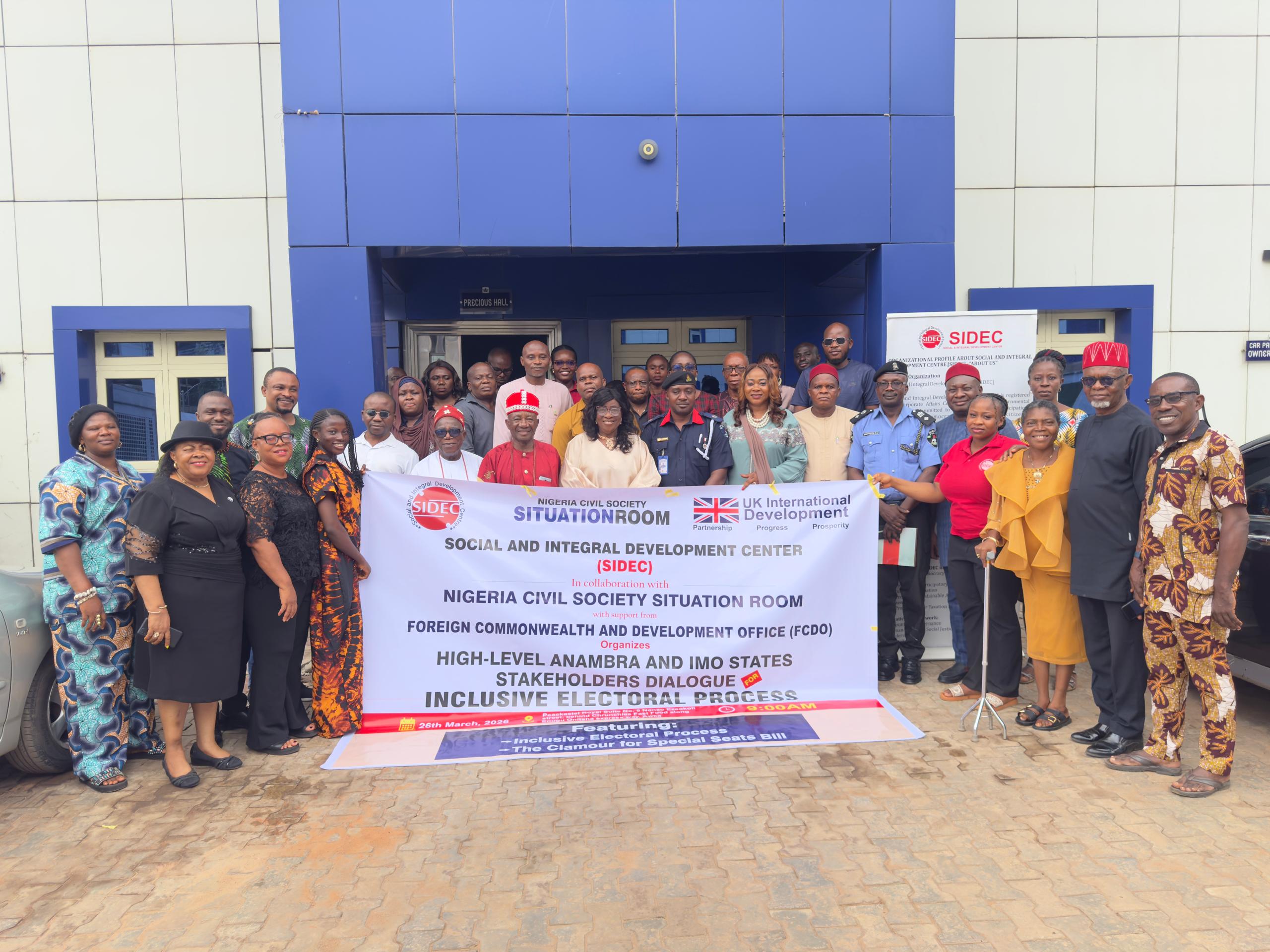
The call was made during a one-day high-level stakeholders’ dialogue on inclusive electoral processes, organized by the Social and Integral Development Centre (SIDEC), a non-governmental organization based in the state.
The event marked the conclusion of Project IMPACT—Inclusive Mobilization for Participation, Advocacy, and Civic Transformation—implemented in partnership with the Nigeria Civil Society Situation Room, with funding support from the UK Foreign, Commonwealth and Development Office (FCDO) across Anambra and Imo states.
Speaking at the forum, a lecturer at Nnamdi Azikiwe University, Awka, Prof. Dennis Aribodor, urged Nigerian women to move beyond complaints and take deliberate steps toward achieving political relevance. He emphasized that organization should be broad-based and inclusive, beginning with educating women on alternatives to current practices that hinder progress.
Aribodor, who is also the Owerri Zonal Coordinator of the Academic Staff Union of Universities (ASUU) and former ASUU chairman at NAU, highlighted the need for capacity building and strategic partnerships. He also called for structures that would encourage competent women to seek elective offices.
He further advocated legislative intervention to address the high cost of obtaining expression of interest forms in political parties, noting that such fees often discourage women and young aspirants from participating in politics.
Also speaking, a gender equality advocate and former Dean of the Faculty of Law at Nnamdi Azikiwe University, Prof. Ogugua Ikpeze, criticized the current political framework, describing it as exclusionary and skewed toward undesirable elements.
She suggested that the cost of nomination forms should be tied to the national minimum wage or scrapped entirely to ensure equal opportunities for all.
Prof. Uche Collins Nwogwugwu, Director of the Institute of Social Policy and Strategic Studies at NAU, stressed the importance of merit, noting that individuals who distinguish themselves are more likely to be considered for leadership roles, regardless of gender or background.
Earlier, SIDEC’s Executive Director, Ugochi Agalaba-Ehiahuruike, said Project IMPACT was designed to promote inclusiveness in governance by ensuring equal opportunities for women, youth, and persons with disabilities.
She noted that the initiative had recorded encouraging outcomes, particularly during the November 8, 2025 governorship election in Anambra State.
She added that the organization aims to develop more effective strategies to boost women’s participation in upcoming local government and general elections in 2027.
Other stakeholders at the event advocated for a more enabling political environment, including the introduction of quotas for women, legal support for the Special Seats Bill, reforms of existing laws, increased political participation, and greater visibility for marginalized groups.
Participants included Labour Party deputy governorship candidate in the 2025 election, Mrs. Ifeoma Okaro; Prof. Jaja Nwanegbo of the Institute for Peace, Security and Development Studies; the traditional ruler of Ideani, Igwe Steven Onyekwelu Ezeji; and the traditional Prime Minister of Ebenebe, Chief Joe Nwegwu, among others.
The dialogue featured panel discussions on inclusive electoral processes and progress under Project IMPACT, alongside the unveiling of the project’s baseline study report.
Awards were also presented, including one to the State Commissioner of Police, Ikioye Orutugu, represented by CSP Harrison Anekwe, in recognition of a peaceful 2025 governorship election in the state.