
Stakeholders Call for Strategic Women’s Movements to Combat GBV
Some gender advocates say that the urgency of tackling Gender-Based Violence (GBV) in Nigeria requires more than dialogue but sustained, grassroots-driven action anchored in strong women-led movements.
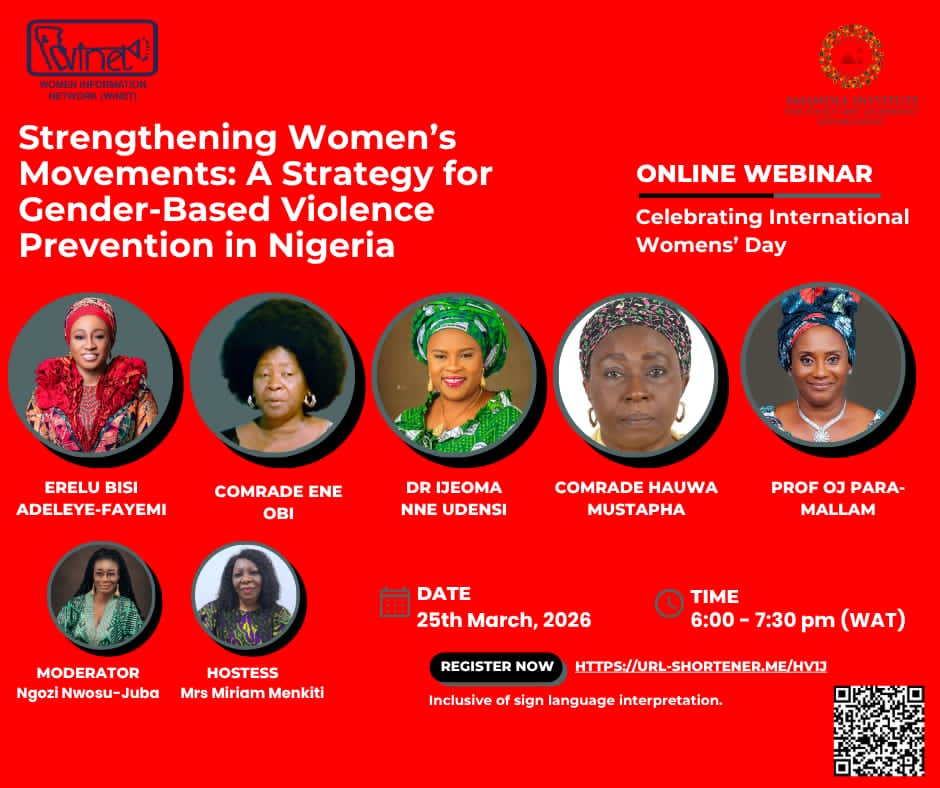
They stated this during a webinar organized by Women Information Network (WINET), as a reflection point and a rallying call for stakeholders to rethink strategies and deepen collaborations.
Speakers emphasized that while policies and frameworks exist, implementation gaps persist, often due to weak coordination and insufficient political will.
A former first Lady of Ekiti State and Co-Founder, Amandla Institute for Policy, and Leadership Advancement, Mrs. Erelu Bisi Adeleye-Fayemi who spoke on “Movement Building and Organising Towards Prevention of GBV,” reinforced that building a formidable movement goes beyond mobilization—it requires intentional leadership development and institutional strengthening.
She noted that without empowering women at the community level, national strategies risk becoming ineffective.
“Movements are not built overnight. They are nurtured through trust, shared vision, and the courage to challenge systems that perpetuate inequality.”
She stressed that women’s movements must adopt what she described as the “Triple A” strategy—Advocacy, Accountability, and Action. “Effective movement building requires a structured focus on seven critical pillars: prevention, access to justice, response, coordination, education, learning, and solidarity.
The Public Relations Officer, National Council of Women Societies, (NCWS) Nigeria, Dr Ijeoma Udensi, speaking on “Using Social Media in Modern Movement Building,” defined movement building as the process of mobilizing people for collective action and influencing social change.
Udensi noted that while social media has not replaced traditional organizing methods, it has significantly expanded the reach, speed, and visibility of movements. “Digital platforms have made it easier to convene meetings, share information, and amplify advocacy messages to wider audiences.”
However, she cautioned that social media must be used deliberately and strategically to achieve meaningful impact. “While social media can ignite movements, it is sustained by people’s commitment and continuous engagement. No woman should be left behind in the movement, regardless of background or circumstance.”
Also speaking, the former Convener, Nigeria Civil Society Situation Room, and Country Director ActionAid Nigeria, Comrade Ene Obi, focused on “Inclusive Women’s Movements in Nigeria: GBV Prevention.”
She highlighted the urgent need for intersectional approaches in addressing violence against women.
Obi underscored the importance of inclusive mobilization, noting that one in three women experiences intimate partner violence, with persons with disabilities often disproportionately affected.
“We must adopt principles of inclusivity in movement building, including survivor-centered approaches such as providing shelters, access to counseling services, and support systems for victims.
“Besides, men and boys are partners in the fight against GBV. We must deliberately engage them to boost the campaign.
In her recommendations, Ene called for the adoption of a comprehensive national GBV strategy, the establishment of clear policies within universities, and the strengthening of inclusive women’s movements that prioritize survivors’ needs and voices.
Participants also examined structural barriers such as poverty, cultural norms, and limited access to justice, which continue to fuel GBV.
Discussions further underscored the need for stronger partnerships between civil society organizations, government institutions, and the private sector. Stakeholders agreed that coordinated efforts would not only enhance resource mobilization but also improve accountability mechanisms.
In addition, there were calls to integrate GBV prevention into educational curricula and community engagement programs, ensuring that awareness begins at an early age. Engaging traditional and religious leaders was also identified as a critical step toward shifting harmful norms and practices.
Closing the session, the convener, and Executive Director, Women Information Network, Mrs Miriam Menkiti, urged participants to translate insights into action, emphasizing that the fight against GBV is a collective responsibility.
“The strength of any movement lies in its consistency,” she said. “We must keep pushing boundaries, amplifying voices, and holding systems accountable until every woman and girl can live free from violence.”
As Nigeria continues to grapple with high rates of GBV, the message from the webinar was clear: stronger, more inclusive women’s movements are not just beneficial—they are essential to achieving lasting change.