Trump Orders Blockade of Hormuz Strait as US–Iran Peace Talks Fail
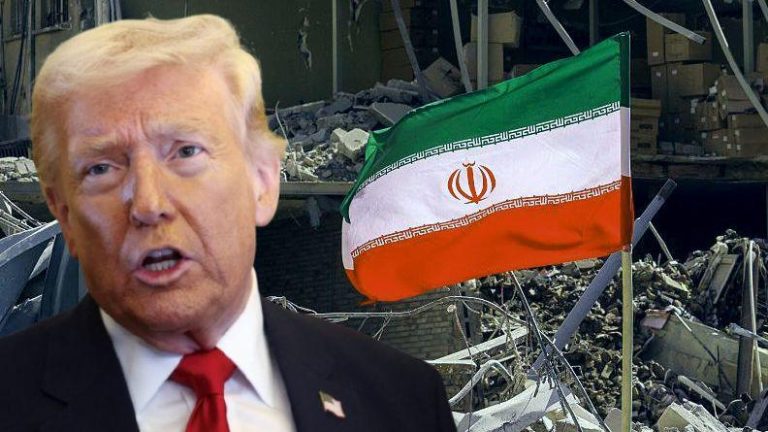
The President of the United States, Donald Trump, has ordered the country’s navy to block the crucial Strait of Hormuz shipping lane.
He gave the order on Sunday after expressing fury over Iran’s refusal to abandon its nuclear ambitions, following the collapse of peace talks in Pakistan without an agreement.
In response to Trump’s announcement, Iran’s Revolutionary Guards warned that they have full control over traffic in the strategic waterway and would trap any enemy attempting to challenge it “in a deadly vortex.”
In a lengthy statement on his social media platform, Trump said his ultimate goal was to clear the strait of mines and reopen it to all shipping. However, in the meantime, Iran must not be allowed to profit from its control of the waterway.
“Effective immediately, the United States Navy, the finest in the world, will begin the process of BLOCKADING any and all ships attempting to enter or leave the Strait of Hormuz,” Trump said. “Any Iranian who fires at us, or at peaceful vessels, will be BLOWN TO HELL!”
Iran has already been restricting traffic through the strait—a key route for global shipments of oil, gas, and fertiliser—while allowing vessels deemed to be from friendly countries, such as China, to pass. There have also been unconfirmed reports that Tehran plans to impose tolls.
“THIS IS WORLD EXTORTION,” Trump said. “I have also instructed our Navy to seek and interdict every vessel in international waters that has paid a toll to Iran. No one who pays an illegal toll will have safe passage on the high seas. We will also begin destroying the mines the Iranians have laid in the strait.”
The US military said on Saturday that two navy warships had transited the strait to begin clearing mines and ensure it was a “safe pathway” for tankers—a claim denied by Tehran.
Iran’s Fars News Agency reported on Sunday that two Pakistani-flagged oil tankers heading toward the strait had turned around.
Fears of renewed fighting have rattled an already tense region following the collapse of US–Iran talks.
‘Act of Extortion’
Trump, speaking later in an interview with Fox News, again threatened Iran’s energy infrastructure and warned he would impose a 50 percent tariff on Chinese imports if Beijing attempted to assist the Iranian military.
“I could take out Iran in one day. I could destroy their entire energy sector—everything, every one of their plants, including electric generating facilities, which is a big deal,” he said.
The president’s latest ultimatum appears to have been triggered by the failure of negotiations to secure a deal to end the six-week-old war, which began when the US and Israel launched strikes on Tehran and killed Iran’s supreme leader, Ali Khamenei.
Iran’s refusal to relinquish its right to a nuclear programme frustrated the US delegation, led by Vice President JD Vance, White House envoy Steve Witkoff, and Trump’s son-in-law, Jared Kushner.
“I have always said, right from the beginning—and many years ago—IRAN WILL NEVER HAVE A NUCLEAR WEAPON!” Trump stated.
“The blockade will begin shortly. Other countries will be involved in this blockade,” he added, without providing further details.
Experts say that blocking the crucial waterway in the middle of a two-week ceasefire, following the Islamabad negotiations, could further erode America’s global credibility.
“Imposing a blockade on the Strait of Hormuz right now—even if it is implementable, which remains an open question—is bewildering and seems self-defeating,” said Shibley Telhami, a professor of peace and development at the University of Maryland.
Vance left Pakistan after the talks—the highest-level meeting between the two sides since the 1979 Islamic Revolution—and warned that Washington had made Tehran its “final and best offer” for a deal, adding: “We’ll see if the Iranians accept it.”
Iran’s parliamentary speaker, Mohammad Bagher Ghalibaf, who heads the country’s negotiating team, said he had “put forward constructive initiatives,” but that the US delegation had failed to gain Iran’s trust.
Ceasefire Efforts
The collapse of the talks has raised concerns that a return to fighting could drive global energy prices higher and further damage shipping, oil, and gas infrastructure.
Pakistan, which hosted the negotiations, urged both countries to continue respecting the temporary truce.
UK Prime Minister Keir Starmer spoke with the Sultan of Oman, Haitham bin Tariq, and both leaders agreed that “it is vital that the ceasefire continues and that all parties avoid further escalation.”
A spokesperson for the European Union said diplomacy would be “essential” to securing peace and praised Pakistan’s mediation efforts. Meanwhile, Russia’s President, Vladimir Putin, spoke with Iranian President Masoud Pezeshkian to offer support for diplomatic efforts.
“Vladimir Putin emphasised his readiness to further facilitate the search for a political and diplomatic settlement to the conflict and to mediate efforts toward achieving a just and lasting peace in the Middle East,” the Kremlin said in its readout of the call.