
Alleged Coup Plot: Defendants Admit Knowledge of Plan to Overthrow Tinubu Administration
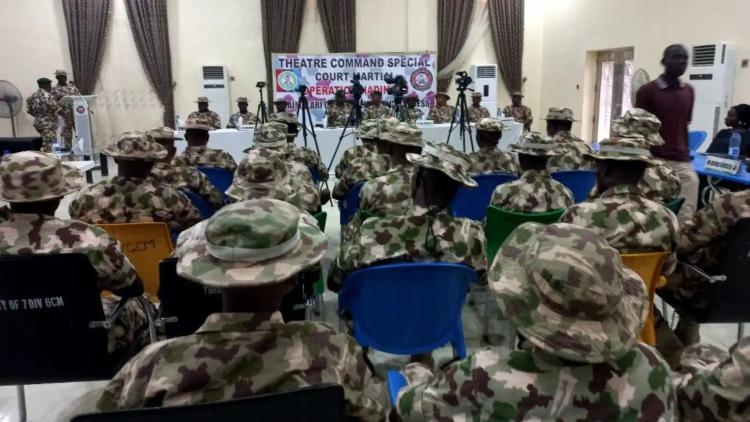
Some of the suspects standing trial over an alleged coup against the administration of President Bola Tinubu have admitted to having knowledge of the plot, with two acknowledging awareness and one denying involvement.
According to video evidence presented at the Federal High Court in Abuja on Monday, recordings of investigators’ interview sessions with three of the six defendants currently being prosecuted were played in open court.
The recordings reportedly captured statements made during interrogations concerning the alleged plan to overthrow the government.
In the footage, two of the defendants—retired Navy Captain Erasmus Ochegobia Victor and Police Inspector Ahmed Ibrahim—admitted being aware of the plot.
However, retired Major General Mohammed Ibrahim Gana denied any knowledge of such a plan.
The recordings, stored on a hard disk submitted by the prosecution, were admitted despite objections from defence counsel.
The defence argued that the statements were not made voluntarily and further objected to the recordings being played before formal admission into evidence. Presiding judge, Justice Joyce Abdulmalik, overruled the objections, stating that playing such recordings in court is standard practice. She noted that the defence’s concerns would be addressed through a trial-within-trial to determine whether the statements were made voluntarily.
In his recorded interview, Major General Gana stated that he retired from the Nigerian Army in 2010 as Chief of Defence Logistics and had since lived a quiet and law-abiding life.
He acknowledged knowing the alleged mastermind, Colonel M. A. Ma’aji, who he said had grievances regarding his stalled promotion.
However, Gana insisted he was unaware of any coup plans and would have reported them had he known.
Gana explained that his name became linked to the investigation due to a ₦2 million transfer traced to him.
He also admitted forwarding, via WhatsApp, a copy of a coup speech previously read by Joshua Dongayaro during an earlier coup in Nigeria, as well as other messages containing anti-government rhetoric. He maintained that he merely forwarded these materials as received and did not originate or edit them.
When investigators suggested that a coup speech recovered from Colonel Ma’aji bore similarities to the one he had shared, Gana said he had no knowledge of such connections.
He also denied allegations of conducting reconnaissance at the Presidential Villa or participating in fundraising efforts, including claims that he sourced billions of naira from a former governor.
Retired Captain Victor, the second defendant, admitted knowing Colonel Ma’aji and being aware of discussions about overthrowing the government.
He said he did not report the matter due to their personal relationship. According to Victor, Ma’aji expressed frustration over his promotion and, “out of anger,” spoke about overthrowing the system.
Victor stated that he advised against such actions and suggested retirement instead.
He further admitted that he was approached to provide financial support, assist in raising funds, or help secure accommodation for the plotters, with promises of a government appointment if the coup succeeded.
He said he declined all such requests.
Despite this, Victor acknowledged maintaining communication with Ma’aji via a secure messaging platform, where coded language was reportedly used.
He insisted that he was not involved in any operational planning and provided no assistance.
Reflecting on his actions, Victor said his relationship with Ma’aji clouded his judgment and expressed regret for failing to report the matter to security agencies.
Appearing remorseful, Victor pleaded for clemency, stating: “I feel so bad that I find myself in this situation,” and likened his circumstances to being in the wrong place at the wrong time.
He appealed to the court for mercy, arguing that if the government could grant amnesty to repentant terrorists and bandits, he too deserved forgiveness, having served the nation meritoriously in the Navy.
Police Inspector Ibrahim, who was attached to the State House, told investigators that he was initially approached to help facilitate Colonel Ma’aji’s promotion through his contacts.
He said their discussions later shifted to alleged plans to overthrow the government.
Ibrahim admitted receiving between ₦1.4 million and ₦1.5 million and participating in reconnaissance activities around the Presidential Villa, including Aguda House.
He said he took photographs of parts of the Villa, including the President’s residence and surrounding terrain, and discussed potential access routes.
He further confirmed that coded terms such as “fertiliser” and “farming” were used during conversations to refer to funding and operational plans.
However, Ibrahim claimed that his involvement stemmed from poor judgment influenced by his relationship with the principal suspect.
He added that he did not take the plot seriously, believing it would be impossible to gain access to the State House.
The court also heard that, at the beginning of each interview session, investigators informed the defendants of the purpose of the audio-visual recordings, in line with the provisions of the Administration of Criminal Justice Act.
The investigators stated that the recordings were intended to ensure that all statements were made voluntarily and without coercion, torture, or inducement.
The defendants were also informed of their right to remain silent.
Further hearing in the case is scheduled to continue on Tuesday at 11 a.m.