
Multiple Taxes, Daily Extortion Threaten Our Livelihood, Anambra Keke Drivers Tell Soludo
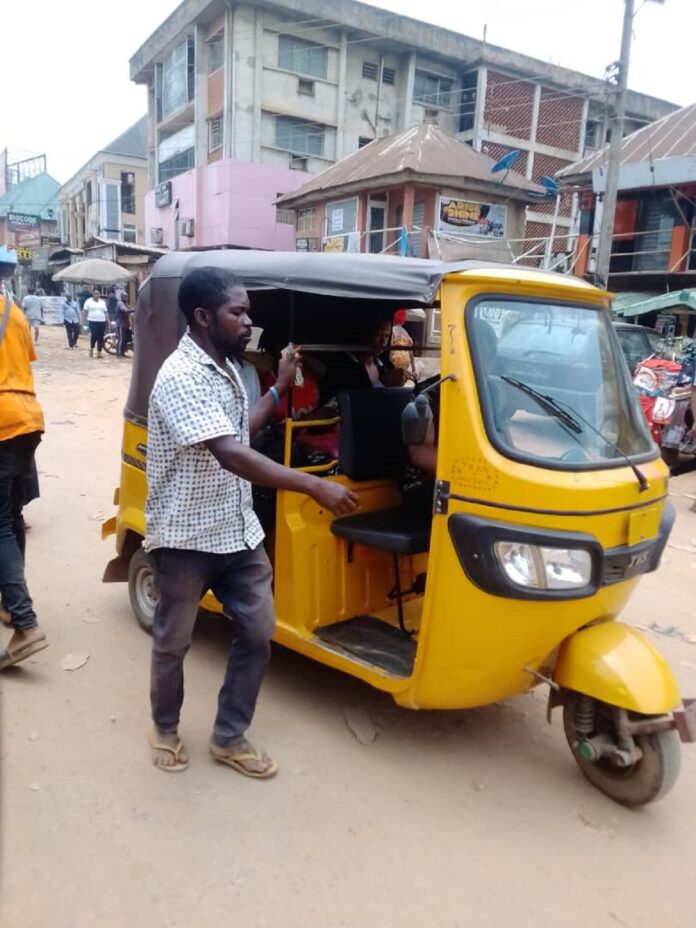
Touts collecting illegal revenues from Keke riders in Anambra State
Members of the tricycle operators’ association under the auspices of the Anambra Keke Drivers Forum (AKDF) have again appealed to Governor Charles Soludo to come to their aid by addressing the challenges of multiple taxation, extortion by touts, and intimidation allegedly being perpetrated against them across the state.
The operators lamented that despite the governor’s earlier assurance that they would not be required to make any additional payments after paying their statutory taxes, they are still being compelled to pay numerous levies imposed by both government agencies and non-state actors.
Speaking with our reporter, the Chairman of the Anambra Keke Drivers Forum (AKDF), Comrade Ifeanyi Okafor, appealed to Governor Soludo to rescue tricycle operators from what he described as persistent harassment, intimidation, and extortion by both state and non-state actors.
According to him, despite the establishment of the state’s Anti-Touting Agency to curb the activities of illegal revenue collectors, popularly known as louts, the touts continue to operate freely at parks, loading points, and along major roads across the state.
He alleged that the touts collect between ₦400 and ₦1,000 daily from tricycle operators in addition to official loading fees.
Okafor cited several instances of the alleged extortion across the state.
At Amawbia Express Park, he said touts collect ₦300 per loading and an additional ₦200 as booking fee.
At Ifitedunu in Dunukofia Local Government Area, he alleged that operators are compelled to pay a daily ₦200 welfare levy and another ₦200 charge whose purpose is unknown.
At Ichida, Awka, he claimed that touts, accompanied by heavily built men, collect ₦1,000 daily from every tricycle operator without any legal justification.
Similarly, at Kwata Park, operators allegedly pay ₦400 daily to touts, while at Eze Uzu Agu, Awka, tricycle riders are reportedly forced to pay ₦300 daily along the road in addition to the approved loading fee.
Okafor expressed regret that whenever the operators report these activities to the Anti-Touting Agency, no meaningful action is taken to stop the extortion, leaving the drivers to fend for themselves.
According to him, many operators now suspect that some members of the Anambra State Anti-Touting Squad (SASA) have compromised and are allegedly working in collaboration with the touts.
He further alleged that tricycle operators can no longer operate freely in Ifite-Awka because of persistent harassment, intimidation, and extortion by louts despite Governor Soludo’s earlier promise to protect commercial transport operators throughout the state.
Okafor also accused the state government of continually introducing new policies and financial obligations for tricycle operators, thereby increasing their economic burden.
According to him, the government has introduced several compulsory requirements, including:
Security Jacket;
Smart Rider’s Permit;
Security Profiling;
Security Colour Code;
Security Enrolment;
T-Code;
U-Code;
H-Code; and
Other related security documentation.
He maintained that each of these requirements attracts additional costs, thereby placing further financial pressure on operators who are already struggling with the country’s harsh economic realities.
Okafor lamented that the government appears to have forgotten that tricycle transportation was introduced as a poverty alleviation initiative aimed at providing employment opportunities for low-income earners.
According to him, no one takes up tricycle riding on commission or by choice, but rather out of necessity to survive the prevailing economic hardship instead of remaining unemployed or becoming a burden to society.
He also criticized the decision of the Anambra State House of Assembly to approve a law making it compulsory for all commercial motorcycle (Okada), tricycle (Keke), and bus operators in the state to wear security identification jackets.
According to him, while the Assembly explained that the policy was intended to strengthen security, enable easier identification of registered operators, and improve passenger confidence, the lawmakers failed to consider the financial hardship such policies impose on transport operators.
Reacting further, Okafor argued that tricycle operators had already undergone government profiling before being issued their T-Codes and registered for tax payments.
He questioned why additional security documentation requiring fresh payments continues to be introduced.
According to him, every new policy comes with another financial demand, making tricycle operators easy targets for both government revenue collection and illegal extortion by touts allegedly operating with official protection.
He recalled that when Governor Soludo assumed office, he assured transport operators that once they paid their statutory taxes, they would not be subjected to any further levies.
He, however, said the reality on the ground is completely different.
“We are paying through our sweat, yet government continues to introduce one policy after another that keeps impoverishing us. We work every day under the sun and in the rain, day and night, only to end up servicing both government revenue demands and illegal touts operating across the state. The governor promised to protect us from louts, but that promise has not been fulfilled. Keke riding is not a job anyone willingly chooses; it is a means of survival in this harsh economy. We do not understand why both government agencies and illegal revenue collectors continue to target Keke operators,” he said.
Okafor also appealed to Governor Soludo to allow tricycle operators to establish an independent union made up exclusively of registered Keke riders.
According to him, such a union would make it easier to monitor members, improve discipline within the sector, and strengthen security across the state.
He further urged the government to conduct elections for tricycle operators, arguing that democratically elected leadership would enhance accountability and assist in addressing insecurity within the transport sector.
He also appealed to the governor to review downward the ₦10,000 renewal fee for Keke particulars, describing the amount as excessive.
According to him, it is unfair that buses and tricycles are made to pay the same renewal fee despite the significant difference in their earnings and operational capacity.
Okafor further complained that under the previous payment system, operators who travelled, fell sick, or had their tricycles undergoing repairs were exempted from daily payment obligations.
He alleged that the current arrangement has removed that flexibility, forcing operators to continue paying government charges even when they are unable to work.
“When Transpay managed our tax collection, our payments were properly monitored and we only paid for the days we actually worked. Today, since Oasis took over, Keke riders are expected to pay even when their tricycles are broken down and in the mechanic’s workshop or when the rider is sick and admitted in the hospital. That was never part of the agreement we had with the governor,” he said.