




OPINION: Ibuzo’s Digital Transport Revolution: A New Dawn for Anambra
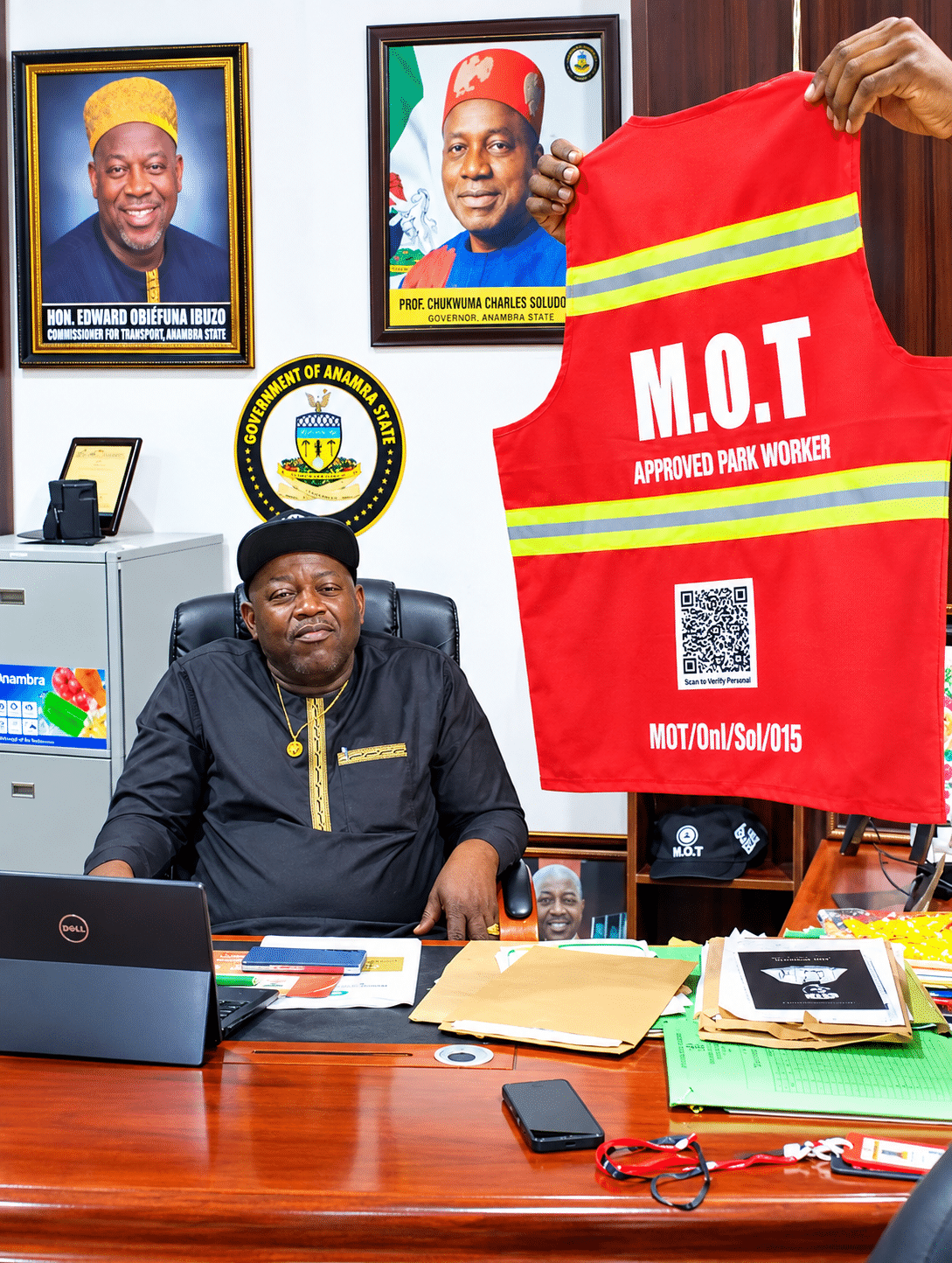
By Titus Eleweke
The transformation of a state’s transportation sector is not measured merely by the construction of roads, the provision of motor parks or the regulation of commercial vehicles.
It is also measured by the ability of government to bring order to daily operations, protect commuters, safeguard transport workers, eliminate illegal practices and deploy technology to solve problems that have persisted for decades.
By this standard, the introduction of digital identification jackets for authorised motor park workers and the commencement of commercial vehicle numbering and profiling in Anambra State represent an important step towards a more organised and accountable transport system.
At the centre of this initiative is the Commissioner for Transport, Hon. Edward Obiefuna Ibuzo, whose reform agenda is focused on modernising a sector that directly affects the security, mobility and economic wellbeing of millions of residents and visitors to the state.
The initiative, unveiled in Awka, is more than a routine government announcement. It represents a shift from an informal system in which identities can be difficult to verify to a structured framework built around identification, documentation, digital records and accountability.
If effectively implemented and sustained, it could significantly change how commercial transportation is administered across Anambra’s 21 local government areas.
For a state that prides itself on enterprise, commercial activity and innovation, the need for a transport system that reflects these aspirations cannot be overstated.
For years, the activities of some unauthorised individuals in motor parks and along major roads have raised concerns among motorists, commercial drivers and commuters. Impersonation, illegal levies, unauthorised loading activities and the exploitation of the identities of government officials have contributed to the challenges confronting transport administration in many urban centres.
The introduction of Ministry of Transport-approved reflective jackets linked to a verifiable identification system offers a practical response to these problems.
By ensuring that recognised park workers can be identified, the government is creating a basis for distinguishing authorised personnel from impostors.
This is a necessary foundation for restoring confidence in the motor park system and protecting genuine transport workers from being unfairly associated with the misconduct of others.
The significance of the initiative lies not in the reflective jackets themselves, but in the administrative structure behind them.
A uniform without verification may amount to little more than a change of appearance.
However, when it is linked to official records, recognised park management structures and a system of monitoring, it becomes an instrument of accountability.
This is where the policy deserves particular attention. It demonstrates an understanding that lasting reform requires more than warnings, occasional enforcement exercises or public declarations.
It requires systems that make compliance verifiable and misconduct easier to identify.
Equally commendable is the clarification that wearing an approved jacket does not confer law enforcement powers or authorise its holder to collect unauthorised fees. This distinction is essential.
Identification must never become a licence for intimidation, extortion or the creation of another layer of unofficial authority.
For the reforms to achieve their purpose, every authorised worker must understand that the jacket represents responsibility, not privilege; service, not superiority; and accountability, not unrestricted power.
Perhaps the most far-reaching aspect of the initiative is the pilot programme for numbering and digitally profiling commercial vehicles operating within Anambra State.
A reliable database containing information about commercial vehicles, their operators and their approved operational details can provide government with a clearer picture of the state’s transport network.
It can also improve coordination between the Ministry of Transport, recognised transport associations, park managers and security agencies.
In practical terms, proper vehicle identification could assist investigations when a commercial vehicle is suspected of involvement in a crime.
It could also support the verification of operators, improve route management, strengthen passenger protection and provide information useful for transportation planning.
These benefits are particularly important in a society where public safety has become an increasingly significant concern.
When vehicles and operators are properly documented, the authorities have a stronger starting point for establishing responsibility and tracing relevant information when incidents occur.
While digital profiling alone cannot eliminate crime, it can close some of the information gaps that make effective monitoring difficult.
This is the promise of technology in public administration: not that it magically solves every problem, but that it gives institutions better tools to identify challenges, make informed decisions and respond more efficiently.
The decision to begin with a pilot phase is also sensible. Testing the system, engaging transport operators, identifying implementation difficulties and making adjustments before statewide expansion can help prevent avoidable complications.
It provides an opportunity to build a system that works in practice rather than one that exists only in official documents.
However, the success of the exercise will ultimately depend on the accuracy of the database, the accessibility of the verification process, the protection of collected information and the willingness of operators to participate.
The government must therefore ensure that digital profiling remains a complementary operational identification measure and does not create confusion with statutory vehicle registration, official number plates or other legally prescribed requirements.
Hon. Ibuzo’s emerging transport agenda deserves to be assessed within the broader responsibilities of his office.
A commissioner is not expected merely to supervise the daily activities of a ministry. The office also demands the ability to identify institutional weaknesses, develop practical solutions, coordinate stakeholders and translate government policy into visible administrative improvements.
The digital identification and vehicle profiling programmes provide an example of the direction in which the ministry is seeking to move.
The approach recognises that the transportation sector cannot be effectively managed if government lacks reliable information about those operating within it.
Regulation becomes more difficult when identities are uncertain, records are incomplete and responsibilities are poorly defined.
By placing identification, registration, digitisation, regulation, monitoring and accountability at the centre of the reform agenda, Ibuzo is addressing some of the structural issues that must be resolved before a modern transport system can emerge.
His stated determination to make Anambra’s transport sector a source of pride and a model for other states is an ambitious undertaking.
The true measure of that ambition, however, will be the consistency with which the announced reforms are implemented and the tangible improvements they deliver to ordinary people.
Public service leadership is most meaningful when policy moves beyond announcements to produce measurable benefits.
The commissioner and his team now have an opportunity to demonstrate that the current initiative can become a lasting institutional achievement.
The reforms also align with Governor Chukwuma Charles Soludo’s wider ambition to modernise public administration and improve service delivery in Anambra State.
Transportation occupies a strategic position in this vision because it connects markets, workplaces, schools, hospitals, commercial centres and residential communities.
An inefficient transport system imposes costs on businesses, wastes commuters’ time, complicates security operations and undermines the smooth movement of people and goods.
Conversely, an organised transport sector can support economic productivity, improve public confidence and create a more predictable environment for commercial activity.
Nevertheless, the reforms must be judged by their outcomes rather than their presentation. Residents will want to know whether illegal levies decline, whether authorised park workers become easier to identify, whether commercial vehicles can be verified, and whether transport operators experience a more orderly and transparent regulatory environment.
These are the benchmarks by which the initiative will earn public confidence.
While applauding the direction of the initiative, it is important to emphasise that transport reform must not become another source of financial pressure on commercial drivers and small-scale operators.
The commissioner has stated that the pilot programme is not intended to impose unnecessary financial burdens on drivers.
This assurance should be reflected in implementation.
The government should communicate the requirements clearly, publish any applicable lawful fees, provide accessible channels for verification and complaints, and ensure that no individual or association exploits the exercise to demand unauthorised payments.
There should also be a transparent procedure for correcting errors in the database, updating records when vehicles or operators change, and resolving disputes arising from registration or identification.
Privacy and data security must receive appropriate attention. Information collected for transport administration should be protected against unauthorised access and used for legitimate purposes within the applicable legal framework.
Furthermore, enforcement must be fair, consistent and firmly grounded in the law.
A digital system will command greater respect when operators understand its requirements and trust that the rules apply equally to everyone.
The objective must be to formalise the transport sector without suffocating the legitimate businesses and livelihoods that sustain it.
The launch of the digital identification jackets and commercial vehicle profiling programme is an important beginning, but it is only one component of the wider task before the Ministry of Transport.
The administration must continue to address motor park management, illegal loading and offloading, traffic discipline, road safety, the coordination of transport associations and the elimination of unauthorised revenue collection.
Equally important is the need for regular engagement with drivers, park workers, association leaders, private park managers and commuters.
These stakeholders are not merely subjects of government regulation; they are essential partners in building a transport system that functions effectively.
The ministry should also establish clear performance indicators to measure progress during and after the pilot phase. Periodic public updates on the number of vehicles profiled, the number of authorised workers identified, the resolution of complaints and the practical effects on security and compliance would strengthen transparency.
Such measures would enable the public to distinguish between the promise of reform and the evidence of results.
The initiative must also be sustained beyond the initial enthusiasm surrounding its launch.
Digital platforms require maintenance, accurate records require continuous updating, and effective regulation demands institutional discipline. Without these, even a promising programme can gradually lose its impact.
The challenge, therefore, is to turn a promising policy intervention into a durable system that continues to serve Anambra residents over time.
The introduction of digital identification jackets and commercial vehicle profiling signals a welcome recognition that the problems of a modern transport sector require modern administrative responses.
Hon. Edward Obiefuna Ibuzo deserves recognition for advancing an initiative that places technology, identification and accountability at the heart of transport management.
The next phase will require sustained commitment, transparent implementation and a willingness to correct weaknesses identified during the pilot exercise.
For commuters, the expected benefit is greater confidence in the people and vehicles with which they interact. For commercial drivers, it is the prospect of a more predictable system in which legitimate operators can be distinguished from impostors.
For government and security agencies, it is the opportunity to work with more reliable information and stronger coordination mechanisms.
For Anambra State as a whole, it is an opportunity to demonstrate that public administration can be modernised through practical reforms that respond to the everyday concerns of citizens.
Ultimately, a successful transport reform is not one that merely introduces digital platforms or distributes official uniforms. It is one that makes life safer for passengers, work more predictable for drivers, administration more transparent for government and the movement of people and goods more orderly for the entire society.
That is the standard by which Ibuzo’s transport reforms should be judged, and that is the opportunity now before the Ministry of Transport.
If the present initiative is implemented with discipline, fairness and continuity, it could become an important foundation for a more accountable and efficient transportation system in Anambra State.
The message is clear: Anambra’s transport sector needs more than routine regulation; it needs a dependable system.
The digital reforms now being introduced offer a practical path towards that goal.
The task ahead is to ensure that the promise of a new transport order becomes a reality experienced by every commuter, driver and legitimate operator across the state.