

UNIZIK Don Pushes Electric Keke to Revolutionize Nigeria’s Transport
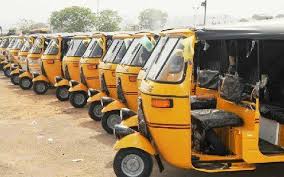
Tricycles
By Our Correspondent
The Federal and State Governments, alongside the organized private sector, have been urged to fund the commercial conversion of auto rickshaws,popularly known as Keke Napep from petrol-powered internal combustion engines (ICE) to electric propulsion.
This, according to Professor Austen Azubogu, Director of the Technology Incubation Centre (TIC) at Nnamdi Azikiwe University (UNIZIK), Awka, is a vital step toward addressing Nigeria’s costly intermediate public transportation system.
Speaking to our correspondent in Awka, Prof. Azubogu emphasized the critical role Keke vehicles play in Nigeria’s transportation ecosystem.
“Over 60 percent of Nigeria’s intermediate transport,which facilitates daily movement from homes to churches, schools, markets, offices, and other locations,relies heavily on auto rickshaws and shuttle buses” .
Currently, these vehicles depend on Premium Motor Spirit (PMS), the price of which has soared following the removal of fuel subsidies by the Bola Tinubu administration. This increase directly inflates the cost of transportation for millions of Nigerians” he said.
Prof. Azubogu stated that electrifying petrol-powered Keke vehicles and deploying smart solar-powered battery charge/swap stations will drastically reduce operating expenses and overall transportation costs.
He explained that converting ICE engines to electric drivetrains powered by rechargeable batteries reduces carbon emissions.
According to him,if the batteries are recharged through solar power,an abundant and cost-free resource,the cost of refueling diminishes significantly, easing the financial burden on commuters.
“The price of petrol in Nigeria is rising daily, and these costs ultimately fall on consumers. Meanwhile, income for Keke operators is effectively depreciating. Furthermore, petrol engines emit fumes and carbon dioxide that contribute to ozone layer depletion,” he said.
He added electric vehicles run on batteries, which can be recharged or swapped at designated stations when depleted, ensuring continuous operation.
Prof. Azubogu pointed to India’s successful model, where approximately 10,000 auto rickshaws are converted to electric monthly.
He lamented the lack of similar momentum in Nigeria, despite some efforts.
The TIC at UNIZIK had submitted a proposal to TETFund seeking funding to initiate this conversion program, beginning with UNIZIK’s fleet. However, the proposal failed to advance beyond the final stage.
He criticized the current approach in parts of Northern Nigeria, where imported electric Keke are offered on hire purchase to youths, calling it unsustainable.
“We have over two million petrol-powered Keke in Nigeria. Importing new electric Keke merely sends the chassis back to India for refurbishment with an electric drivetrain before being resold here. Why not convert the existing vehicles instead? The chassis are durable and suitable for conversion, which would save resources,” he argued.
Despite the setback with TETFund, the university is now turning to crowdfunding to prove the viability of the initiative. The research team at TIC-UNIZIK has already successfully converted one TVS King petrol-powered Keke into a battery-electric vehicle using a custom-designed integrated conversion kit.
The team is also developing solar-powered charge/swap stations designed to facilitate quick battery exchanges. “Our concept involves modular charge/swap stations equipped with solar panels, inverters, and charge controllers. Keke operators can swap depleted batteries for fully charged ones and pay a small fee,”
“These stations can be located conveniently at filling stations, supermarkets, and mechanic workshops. They are smartly designed to monitor battery levels and alert operators to swap batteries before complete depletion, prolonging battery life,” he added.
He noted the approach could be extended to four-wheel vehicles like shuttle buses by replacing ICE engines with custom electric drivetrains.
Addressing concerns that electrification might reduce Nigeria’s oil revenues, Prof. Azubogu clarified, “Nigeria primarily exports crude oil but imports most of its refined petroleum products. Electrifying our transport system would reduce our dependency on imported refined fuels without affecting crude oil exports.”
He further noted that Nigeria spends more on importing refined petroleum products than it earns from crude oil exports.
A professor of Electronics, Azubogu called on the Federal and State Governments, the National Automotive Design and Development Council, TETFund, and the private sector to support the conversion of Keke vehicles to electric powertrains. He emphasized that research has proven the feasibility of the project.
He also stressed the importance of discouraging the importation of fully built electric Keke, advocating instead for support to local research institutions like TIC-UNIZIK to develop homegrown solutions tailored to Nigeria’s unique context.
“All we are asking for is funding,modest funding based on a viable business model. We requested less than 40 million naira from TETFund to set up two charge/swap stations and convert two ICE Keke to electric, as a pilot. This was still at the research stage,” he revealed.
“The solution must be indigenous, taking into account Nigeria’s peculiarities and allowing for ongoing research and improvements,” Prof. Azubogu concluded.