
Soludo Proposes ₦757.8bn for Anambra’s 2026 Fiscal Year, Promises More Impactful Governance
Soludo Proposes ₦757.8bn for Anambra’s 2026 Fiscal Year, Promises More Impactful Governance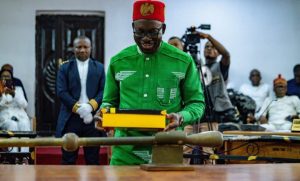
The Governor of Anambra State, Prof. Chukwuma Charles Soludo, on Tuesday presented a proposed budget of ₦757,884,487,705 for the 2026 fiscal year to the State House of Assembly.
Presenting the budget, Soludo noted that the proposal represents a 24.1% increase over the 2025 budget of ₦606,991,849,118, describing it as evidence of his administration’s intensified focus on execution.
According to him, recurrent expenditure is projected at ₦162.6 billion, a 16.6% year-on-year growth, while capital expenditure stands at ₦595.3 billion, representing a 26.3% increase compared to 2025.
He emphasized that capital expenditure constitutes 79% of the total budget size, with recurrent spending taking 21%, which he described as a clear demonstration of the government’s commitment to delivering tangible outcomes for Ndi Anambra.
The governor stated that the budget deficit is estimated at ₦225.7 billion, representing 29.8% of the total budget size. He explained that, if necessary, this deficit would be financed through hybrid funding options, including possible privatization proceeds, improved internally generated revenue (IGR), and concessionary borrowing strictly for bankable projects.
However, he reiterated that since the beginning of his administration no borrowing has been undertaken to finance budget deficits, adding that depending on the pace of execution in 2026, borrowing may still not be required.
“Our fiscal discipline remains firm,” Soludo said, noting that all key sectors recorded year-on-year increases compared to 2025:Administrative Sector – 12.2%,Economic Sector – 26.7%,Social Sector – 31.4%,Education – 46.9%,Health – 13% and Infrastructure Investments – 27.7%
“These increases reflect our priorities in strengthening human capital, boosting economic growth, expanding critical infrastructure, and securing the well-being of Ndi Anambra,” he added.
Soludo explained that the government’s focus for 2026 is to deepen and consolidate the foundations laid in his first tenure while introducing new legacy projects that will shape Anambra’s future for decades.
He reaffirmed that the administration’s central priorities remain security, law and order; infrastructure and economic transformation; and human capital development, noting that at least 70% of the budget is allocated to these critical sectors.
He highlighted ongoing progress in the state’s transport infrastructure revolution, including the dualization of strategic roads, construction of bridges and flyovers, and investments in mass transit systems.
He announced plans to expand waterway transportation through new jetties and boats, and ongoing exploration of public-private partnerships (PPP) to finance the state’s Rail Masterplan.
The governor also noted that substantial progress in the development of new urban centres—Awka 2.0, Greater Niger, and the Aerotropolis/New Industrial-Commercial City—and revealed that construction of the Anambra Mixed-Use Industrial City will commence in 2026.
Soludo reaffirmed commitments to improving the ease of doing business, assuring investors that Anambra remains an attractive destination for both local and foreign capital.
On education, the governor announced plans to deepen ongoing investments in the sector, including sustaining free and qualitative education and the bursary scheme.
He revealed that construction of new public primary schools will begin in 30 of the 76 communities that have never had one, setting a new benchmark for educational infrastructure in the state.
He stated that the aggressive upgrade of primary and secondary school facilities through programmes such as ASUBEB will continue, alongside the establishment of two new specialist tertiary institutions.
The government will also strengthen collaboration with mission schools, which continue to receive state support through staffing and infrastructure partnerships.
On healthcare, Soludo said the administration will deepen ongoing interventions while completing investment in the entire healthcare ecosystem, including the College of Nursing and a new specialist teaching hospital with a focus on oncology. Renovation and equipping of existing primary and secondary health facilities will also continue.
The governor highlighted plans to scale up the One Youth, Two Skills programme to empower more young people with entrepreneurial capacities.
He reaffirmed the state’s commitment to digital skills development, including the completion of the Solution Innovation District (SID) building and expansion of the district through private-sector collaboration.
Soludo stressed that access to clean water is not a luxury, pledging to expand water schemes to ensure safe and reliable water for households and industry. He added that the state is intensifying efforts to extend electricity to underserved communities and provide affordable power to key business corridors.
He noted that the state has developed a regulatory framework for the Anambra Electricity Market, inaugurated the Anambra State Electricity Regulatory Commission (ASERC), and successfully secured the transfer of regulatory oversight from NERC in line with the 2023 Electricity Amendment Act—signalling readiness for private-sector investment in the power sector.
The governor also emphasized the administration’s commitment to social welfare, explaining that tens of thousands of vulnerable households will receive improved seedling distributions including coconut, palm, ukwa, pawpaw, and soursop. Grants will also be provided to micro-businesses across the 326 wards, in line with the government’s commitment to inclusive growth.
He described the 2026 budget as “a blueprint of solutions—a framework for disciplined growth and a strategic response to our economic realities.” With a dollar value of approximately $520 million, Soludo noted that the budget remains modest when adjusted for inflation and the depreciated value of the naira.
Soludo reaffirmed that the administration will borrow only under two strict conditions,the loan must be concessionary with low interest rates and borrowed funds must finance projects with clear repayment frameworks.
“No borrowing for consumption. No borrowing for frivolity,” “Only borrowing to build assets, generate revenue, and strengthen the future.”he insisted.
The governor acknowledged that funding the budget remains one of the state’s greatest challenges. While Anambra ranks No. 1 in fiscal transparency and sustainability, he noted that IGR remains the state’s weakest link, with performance consistently falling short of potential. A technology-driven revenue reform will soon be launched to block leakages, expand the tax net, support willing taxpayers, and enforce compliance where necessary.
Soludo praised communities and stakeholders who continue to invest heavily in local development—building roads, upgrading schools and hospitals, co-funding security, and complementing government efforts.
He stated that counterpart funds have been set aside in the budget to strengthen partnerships with the federal government, development agencies, the private sector, and local governments.
He expressed deep gratitude to the Solution Team, the 8th Assembly, the judiciary, civil servants, teachers, security agencies, community leaders, traditional rulers, religious bodies, the media, NGOs, youths, women, and students.
“I assure you that every kobo entrusted to us will be deployed prudently, transparently, and with maximum value for our people,” Soludo said. “Ndi Anambra have placed their trust in us, and together with our Solution Team, we will continue working day and night to build the prosperous, livable, smart homeland we envision.”he Said.