




SPARK 2, Health Stakeholders Intensify Push for Health Insurance Enrolment in Anambra
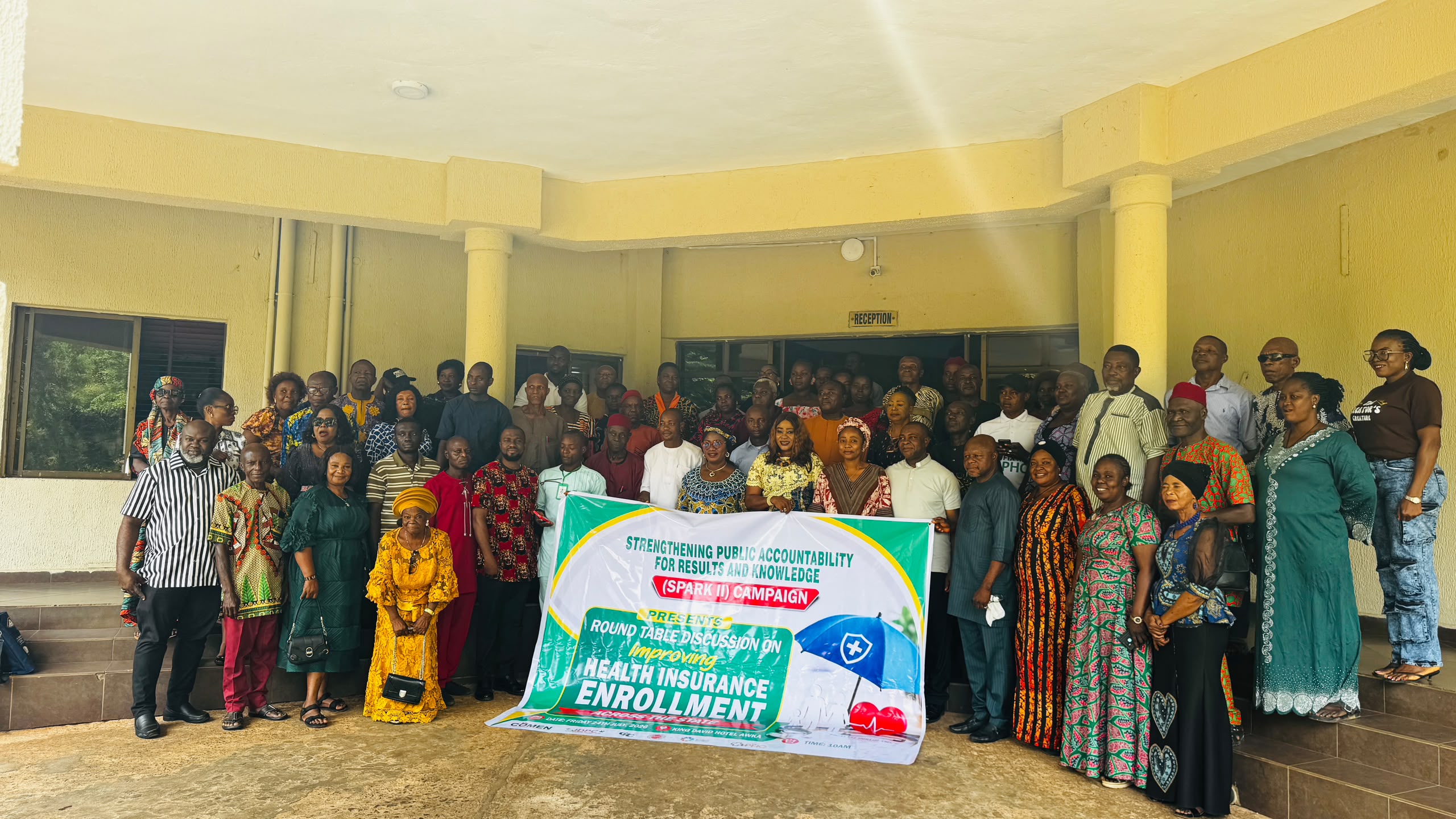
Partners implementing the Strengthening Public Accountability for Results and Knowledge (SPARK 2) project and key health stakeholders in Anambra State have adopted a community-driven approach to expand health insurance enrolment among women of child-bearing age and other vulnerable groups, with town unions, community leaders and Ward Development Committees taking centre stage in the mobilisation campaign.
The strategy was adopted at a multi-stakeholder roundtable convened under the SPARK 2 project, supported by the International Budget Partnership (IBP), where participants agreed that sustained grassroots mobilisation was critical to increasing enrolment into the Anambra State Health Insurance Agency (ASHIA) scheme.
The meeting brought together representatives of the National Identity Management Commission (NIMC), National Health Insurance Authority (NHIA), National Orientation Agency (NOA), Anambra State Health Insurance Agency (ASHIA), Anambra State Primary Health Care Development Agency (ASPHCDA), Anambra State Town Unions Council (ASTUC), Joint National Association of Persons with Disabilities (JONAPWD), community development organisations and traditional institutions.
Participants resolved to maximise the ongoing ward-to-ward National Identification Number (NIN) registration exercise to ensure that more women of reproductive age and other vulnerable residents obtain the identity number required for enrolment into the state health insurance scheme.
Permanent Secretary, Anambra State Ministry of Health, Dr. Obiageli Uchebo, described the mandatory NIN requirement as one of the major barriers preventing many indigent residents from benefiting from healthcare under the Basic Health Care Provision Fund (BHCPF).
She explained that while beneficiaries are required to possess a NIN before they can be enrolled through ASHIA, many children, elderly persons and indigent residents are yet to obtain one.
“This discussion is timely because it brings together government agencies and community leaders to find practical solutions. Government is pleased to be part of this initiative,” she said.
Director of Justice Development and Peace Caritas (JDPC), Nnewi, Rev. Fr. Benedict Okolo, said the engagement was designed to identify practical solutions that would improve maternal and child healthcare through increased health insurance coverage.
“For all SPARK 2 partners, this meeting is very important to further improve maternal and child healthcare in Anambra State. We want all stakeholders to work with us to improve the enrolment rate especially for women of child-bearing age.
Executive Director of the Civil Rights Council (CRC), Okey Onyeka, described the meeting as an opportunity to jointly address barriers affecting pregnant women and nursing mothers. Let’s drive this goal together and posterity will be kind to us all.”
Executive Director of the Social and Integral Development Centre (SIDEC), Ugochi Ehiahuruike, said the collaboration among government institutions, development partners and community leaders would strengthen access to health insurance for women of child-bearing age.
She commended the cooperation between NIMC, NHIA, ASHIA, ASPHCDA, and NOA urging town unions, local government officials and community leaders to sustain grassroots mobilisation.
“We are taking this route for the first time. To all of you we say – let’s work together to achieve improved enrollment of women of reproductive age into health insurance.”
Introducing the SPARK 2 project, Programme Officer of JDPC Nnewi, Onyekachi Ololo, said findings from community engagements showed that the NIN requirement remained one of the biggest barriers to health insurance enrolment, making the roundtable necessary.
“Findings from community engagements revealed that the NIN requirement remained one of the biggest barriers to health insurance enrolment, prompting the convening of the roundtable.”
According to him, the project seeks to improve maternal healthcare by expanding health insurance enrolment, strengthening accountability in primary healthcare financing, improving referrals from traditional birth attendants, building the capacity of Ward Development Committees and sustaining community advocacy.
The Acting Executive Secretary of ASPHCDA, Dr. Ngozi Okeke, represented at the event urged Ward Development Committee chairmen to intensify sensitisation across communities, especially among women of child-bearing age, to improve enrolment into the health insurance scheme.
Anambra State Town Unions Council, (ASTUC) Vice Chairman, Comrade Chike Ugboma, called on the National Orientation Agency to intensify public enlightenment on NIN registration, while President of the ASTUC Women Wing, Mrs. Blessing Onuigwe, pledged to mobilise women through the annual August Meeting and other community platforms.
She pledged commitment to the cause to enable more women to benefit from the scheme.
NIMC Local Government Coordinator, Simeon Modebe, assured participants that the ongoing ward-to-ward NIN registration exercise had been extended until further notice and remained free of charge, urging residents to report any cases of extortion.
ASHIA’s Head of Planning, Research and Statistics, Tochukwu Ibeziako, noted that the NIN requirement continues to slow progress towards Universal Health Coverage because many vulnerable Nigerians are unable to obtain the identity number required for enrolment.
Stakeholders resolved to deepen collaboration with community structures, intensify grassroots awareness campaigns, leverage the ward-to-ward NIN registration exercise and encourage well-meaning individuals to support indigent residents, with the goal of increasing health insurance enrolment among women, children and other vulnerable groups across Anambra State.
