





OPINION:Alex Otti and the Rebirth of Abia: How Performance Is Redefining Governance
By Titus Eleweke
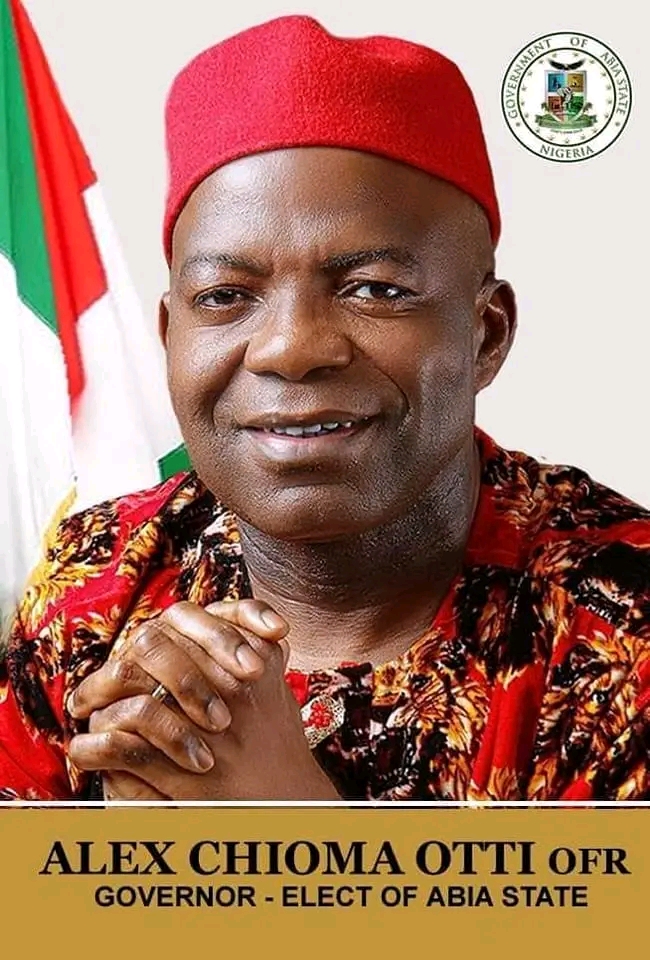
The administration of Governor Dr. Alex Chioma Otti has introduced a refreshing dimension to governance in Abia State. In a relatively short period, his leadership has demonstrated that purposeful governance, driven by competence, transparency, and accountability, can produce tangible results.
For many residents, the democratic experience under the current administration is unlike anything the state has witnessed since Nigeria’s return to civil rule in 1999.
One of the hallmarks of the Otti administration has been the prompt payment of civil servants’ salaries. This has restored confidence among workers and reinforced the principle that government exists to serve its people. Beyond this, significant attention has been directed towards critical sectors such as healthcare, education, infrastructure, commerce, and public service delivery.
As a caring governor, Otti has constructed what many regard as one of the best modern motor parks in the country. His administration has also introduced free medical services for elderly citizens and cleared outstanding pension arrears owed to retirees. Some pensioners had been owed between three and four years of unpaid pensions. These interventions have brought relief to thousands of retirees who devoted their productive years to serving the state.
Education, which remains the cornerstone of sustainable development, has also received renewed priority. The Otti administration has invested in the recruitment of teachers and increased funding for tertiary institutions, including Abia State University, Abia State Polytechnic, and Abia State College of Education. It has also initiated reforms aimed at revitalising institutions that had suffered years of neglect.
For decades, many Abians believed that the state was governed by leaders whose political loyalty was directed more towards their benefactors than to the people. This perception fostered a culture of weak accountability, where promises frequently outweighed performance.
Previous administrations were often accused of announcing projects that existed only on paper while investing heavily in publicity campaigns designed to create an illusion of progress. Elaborate media promotions sometimes substituted for genuine development, leaving many communities without the infrastructure and essential services they had been promised.
Consequently, many citizens became disillusioned and lost confidence in government.
One of the most controversial issues associated with previous administrations was the proposed Abia Airport project. Questions surrounding its funding, planning, and eventual abandonment generated widespread public debate and continue to attract calls for greater transparency and accountability.
The emergence of Dr. Alex Otti marked what many consider a turning point in the political history of Abia State.
His election was widely seen as breaking a cycle of politics dominated by entrenched interests. His administration has inspired renewed hope that governance can indeed be centred on competence, integrity, and genuine service to the people.
Today, Abia has begun to witness measurable improvements in infrastructure, public administration, accountability, and economic development. Aba, once synonymous with dilapidated roads and perennial flooding, is gradually being transformed through extensive road reconstruction and improved drainage systems. These interventions have enhanced commercial activities and restored confidence in the government’s capacity to deliver. Aba is steadily reclaiming its position as one of the leading commercial centres in the South-East and Nigeria as a whole. For years, poor road infrastructure discouraged business activities while successive political leaders appeared indifferent to the plight of traders and residents.
Today, Abia is increasingly attracting positive national attention for its governance reforms and developmental initiatives. Many residents now express a renewed sense of pride in a state striving to live up to its slogan, “God’s Own State.”
As discussions about future elections gradually gather momentum, those aspiring to govern the state should recognise that the electorate is becoming increasingly discerning. Political ambition should be accompanied by credible ideas, a demonstrable record of service, and a genuine commitment to the welfare of the people,qualities that many supporters believe Governor Otti has demonstrated.
Many Abians believe they cannot abandon the leader they credit with restoring hope and putting smiles on the faces of ordinary citizens. In their view, there is no vacancy in the Government House as long as the current administration continues to meet the expectations of the people.
The support Governor Otti enjoys among many residents is not confined to a single political party but cuts across different political affiliations.
Ultimately, the people of Abia will determine the state’s future through the ballot box. As long as the present administration continues to deliver on its promises, it is understandable that many citizens will support the continuity of policies they believe are advancing the state’s development.
Governor Alex Otti’s administration has undoubtedly changed the conversation about governance in Abia State. Across different segments of society, many residents acknowledge the visible improvements recorded so far.
While political opponents may be reluctant to publicly commend the administration because of party loyalty, many observers believe that, in private conversations, even some critics acknowledge the government’s developmental initiatives and visible achievements.
However, the administration must sustain its momentum, deepen institutional reforms, and ensure that the gains already recorded become enduring legacies for future generations.
Titus Eleweke is an Anambra-based journalist.