

NACTAL, Anambra Intensify Anti-Human Trafficking Campaign, Urge Public to Speak Up
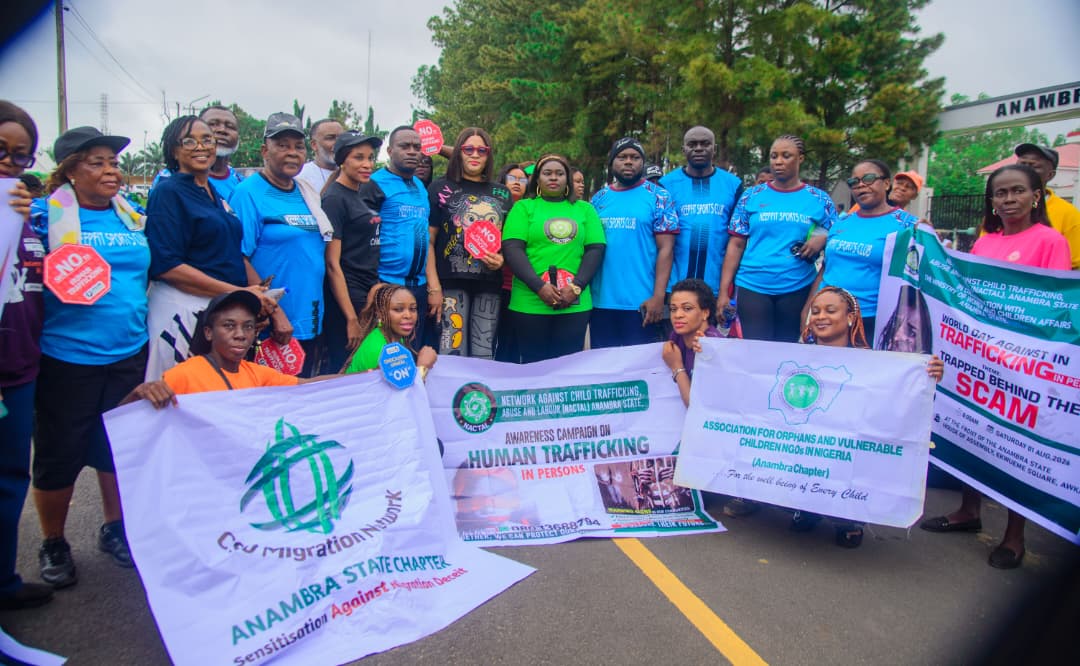
The Network Against Child Trafficking, Abuse and Labour (NACTAL), in partnership with the Anambra State Government, security agencies and other stakeholders, has intensified efforts to combat human trafficking in the state by taking its awareness campaign to the streets of Awka .
They urged residents to expose traffickers before more lives are destroyed by false promises of greener pastures.
The sensitisation campaign, held to commemorate the 2026 World Day Against Trafficking in Persons, brought together officials of the International Federation of Women Lawyers (FIDA), the Nigeria Security and Civil Defence Corps (NSCDC), the Nigeria Immigration Service (NIS), the Anambra State Ministry of Women Affairs and Social Welfare, and other partners.
With the theme, “Trapped Behind the Scam,” participants marched from the Anambra State House of Assembly Complex to major motor parks and other public places in Awka, educating residents on the dangers of human trafficking, irregular migration, and the deceptive tactics traffickers use to lure unsuspecting victims.
Speaking during the exercise, the Commissioner for Women and Social Welfare, Mrs Esther Onyekesi, reaffirmed the Anambra State Government’s zero-tolerance stance on human trafficking and related crimes.
She commended NACTAL for its strategic partnership with the government in prioritising the fight against human trafficking and irregular migration, assuring that the ministry would continue to collaborate with organisations committed to protecting vulnerable persons.
The Anambra State Coordinator of NACTAL, Eucharia Onyemaobi, stressed the need for families to become better informed, describing awareness at the family level as one of the most effective tools for preventing human trafficking.
Highlighting the tactics employed by modern-day traffickers, Onyemaobi listed fake job offers, fraudulent scholarship opportunities, deceptive travel arrangements, false promises of marriage, online friendships, and misleading social media advertisements as some of the methods used to lure victims.
“We have seen many innocent persons fall prey to the promise of a better future, only to find themselves exploited through forced labour, sexual exploitation, domestic servitude, forced begging, criminal activities, or other forms of abuse.
“Sadly, many of these victims are women, children, and vulnerable young people whose dreams are manipulated by traffickers.
“This is why our continued silence can no longer continue.
“We also acknowledge that social issues such as poverty, unemployment, ignorance, family pressure, irregular migration, and the increasing misuse of digital platforms have made many people vulnerable to trafficking.
“Every family, every community, every school, and every institution has a role to play in preventing this crime.
“When we talk about human trafficking, we are talking about deceit, exploitation, organ harvesting, and other forms of abuse. Families must be informed so they can make the right decisions and protect their loved ones,” she said.
Onyemaobi urged young people not to allow desperation or the glamorous lifestyles portrayed on social media to influence dangerous decisions.
“Many traffickers exploit people’s desire for quick success. Not everything you see on social media reflects reality,” she warned.
She noted that the public sensitisation campaign at motor parks generated encouraging feedback, with many participants asking questions that would help shape future advocacy and policy engagement. She stressed the need for stronger collaboration among stakeholders to achieve the results the state desires.
The NACTAL coordinator also commended Governor Chukwuma Soludo for signing the Anambra State Human Trafficking Law and praised the Governor’s wife, Dr Nonye Soludo, for supporting trafficking survivors, including the recent rescue and rehabilitation of a victim.
She, however, appealed to the government to intensify efforts against human trafficking, particularly internal trafficking, which she described as an emerging threat.
She also emphasised the need for the effective implementation and enforcement of the Anambra State Anti-Human Trafficking Law to ensure that perpetrators are duly punished and to serve as a deterrent to would-be offenders.
Also speaking, the Chairperson of the International Federation of Women Lawyers (FIDA), Anambra State Branch, Barr. Amara Muojeke, said traffickers prey on people’s desire for better economic opportunities by offering fake jobs and false promises of a brighter future.
She urged residents to promptly report suspected trafficking cases to FIDA, the Ministry of Women Affairs and Social Welfare, the Nigeria Immigration Service, the NSCDC, and other relevant agencies.
Muojeke cited the recent rescue of trafficked victims in Aguleri, Anambra East Local Government Area, as evidence that timely reporting can save lives.
“Those children were rescued because someone spoke up. If you suspect any case of trafficking, do not keep silent. Report it immediately because every victim is someone’s child, sister, or brother,” she said.
While acknowledging that economic hardship contributes to human trafficking, she insisted that it should never be an excuse, pointing to the Anambra State Government’s ‘One Youth, Two Skills’ initiative as a viable empowerment programme capable of reducing youths’ vulnerability.
The Deputy Commandant of the NSCDC and Head of the Anti-Human Trafficking Unit, Edith Ebere Nwufoh, explained that traffickers operate through what she described as the three Rs—Reason, Recruitment, and Routes.
She said traffickers are driven by financial gain, recruit victims through deception, and carefully plan the routes used to move victims across states and international borders.
Nwufoh appealed to commercial drivers and transport operators to partner with security agencies by reporting suspicious movements involving children and young persons.
She also highlighted the three Ps of anti-human trafficking efforts—Prevention, Prosecution, and Partnership—emphasising that defeating human trafficking requires the collective efforts of parents, teachers, religious leaders, transport operators, security agencies, and civil society organisations.
Participants at the campaign called on Nigerians to remain vigilant, reject deceptive offers, and promptly report suspicious activities, insisting that sustained public awareness remains one of the most effective tools for ending human trafficking.