




Anambra Stakeholders Strengthen TBA Referral System to Improve Safe Motherhood
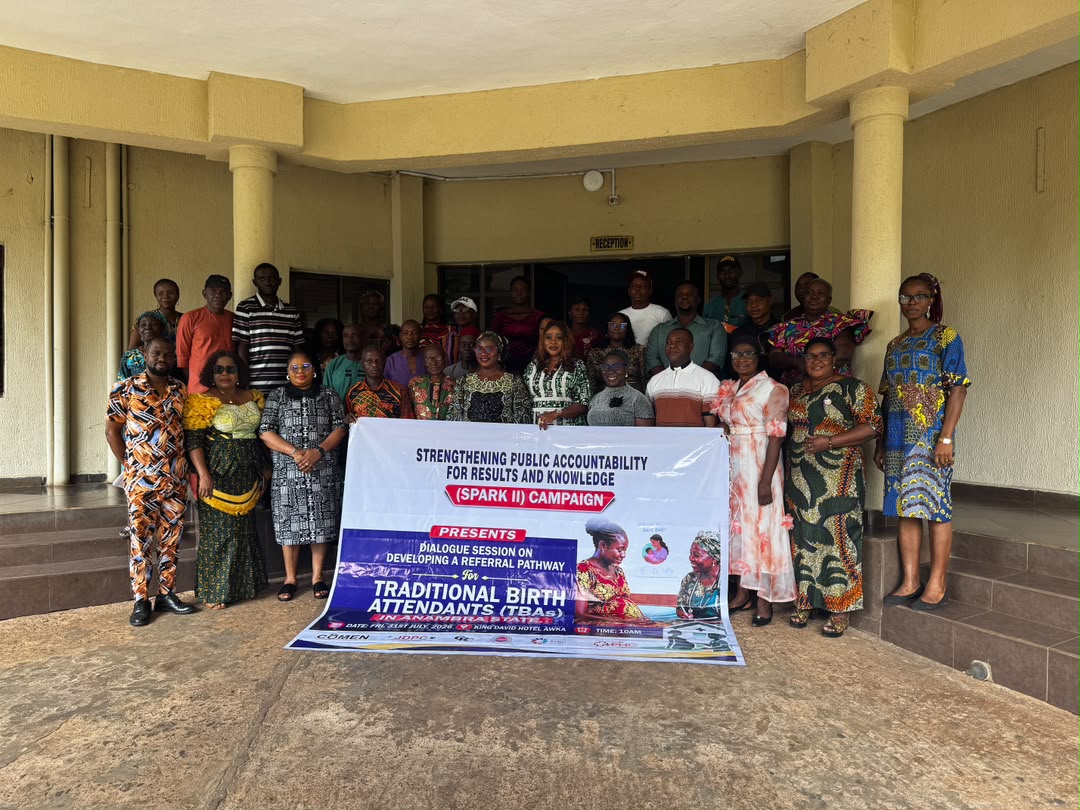
Stakeholders implementing the Strengthening Public Accountability for Results and Knowledge (SPARK 2) project have commenced the process of developing a structured referral pathway linking Traditional Birth Attendants (TBAs) with Primary Healthcare Centres (PHCs) in Anambra State as part of efforts to reduce maternal and newborn deaths.
The initiative, supported by the International Budget Partnership (IBP), brought together civil society organisations, state and local government officials, primary healthcare managers and traditional birth attendants to design a practical framework that will ensure pregnant women experiencing complications are promptly referred to appropriate health facilities for skilled care.
SPARK 2 is being implemented in Anambra State by Justice Development and Peace Caritas (JDPC) Nnewi, Civil Rights Concern (CRC), Social and Integral Development Centre (SIDEC) and Community Empowerment Network (COMEN).
Welcoming participants, the Director of JDPC Nnewi, Rev. Fr. Benedict Okolo, acknowledged the important role TBAs continue to play in communities where access to healthcare remains limited, noting that government health facilities alone cannot meet the needs of every pregnant woman.
He, however, stressed the need for stronger collaboration to ensure expectant mothers receive appropriate care when complications arise.
“We know you are filling a gap, but things have to be done properly. Government facilities cannot do everything, which is why this conversation is necessary,” he said.
Presenting a paper on current maternal health referral practices, the Executive Director of the Social and Integral Development Centre (SIDEC), Mrs. Ugochi Ehiahuruike, noted from the testimonies of Traditional Birth Attendants that referrals were largely informal, inconsistent and dependent on individual discretion rather than a structured institutional framework.
She stressed that the initiative was not designed to stop TBAs from practising but to ensure they operate within a coordinated maternal healthcare system that prioritises the safety of mothers and newborns.
“Many people in hard-to-reach communities trust TBAs, but there are conditions they should never manage. We discovered that there is no institutionalised referral system,” she said.
Ehiahuruike identified delayed recognition of pregnancy complications, weak communication between Primary Healthcare Centres and TBAs, under-utilisation of skilled birth attendants and poor linkage of pregnant women to health insurance programmes as major challenges undermining maternal healthcare.
She recommended the establishment of a comprehensive database of TBAs, continuous capacity building, a referral monitoring dashboard and incentive packages that would encourage TBAs to refer complicated cases instead of retaining them.
“When TBAs refer complicated cases, they often lose their customers. Government should therefore develop incentive packages that encourage referrals rather than discourage them,” she added.
Executive Director of Civil Rights Concern (CRC), Mr. Okey Onyeka, stressed the need for stakeholders to critically examine existing maternal health policies, assess how effectively they are being implemented and identify policy gaps hindering collaboration between TBAs and government health facilities.
“We need to understand the level of coordination between government and traditional birth attendants and how that relationship can be strengthened to save more mothers and children,” Onyeka said.
COMEN State Chairman, Chief Ide Godwin Eze, said the overriding objective was to ensure every woman of child-bearing age delivered safely and that both mother and child remained healthy after childbirth.
“We appreciate what you are doing, but there are situations beyond your capacity. Let’s discuss frankly so we can put our state in order and reduce avoidable deaths,” he stated.
Providing further context for the engagement, Programme Manager of JDPC Nnewi, Mr. Onyekachi Ololo, identified delayed referrals as one of the biggest weaknesses in maternal healthcare involving TBAs.
He explained that the dialogue was designed to establish a functional and sustainable referral relationship between TBAs and Primary Healthcare Centres across the state.
Ololo noted that many women continued to patronise TBAs because they were closer to communities, charged affordable fees, treated clients with empathy and enjoyed deep cultural acceptance.
“People who patronise TBAs often cut themselves off from government health insurance programmes. Many government health workers also need to improve their human relations because these interpersonal qualities partly explain why women continue to patronise TBAs,” he said.
In her remarks, the Permanent Secretary, Anambra State Ministry of Health, Dr. Obiageli Uchebo, reaffirmed government’s recognition of the role played by TBAs but insisted that maternal healthcare must comply with accepted professional standards.
“We appreciate your work, but you must not insist on conducting deliveries that have become complicated. In Anambra, TBAs must engage qualified personnel and register with government. Upgrade yourselves and you will benefit more from government programmes,” she said.
Former Acting Executive Secretary of the Anambra State Primary Health Care Development Agency, Dr. Ngozi Okeke, alongside the State Health Educator, Mrs. Uju Onwuegbusina, advised TBAs to establish stronger working relationships with nearby Primary Healthcare Centres.
Primary Healthcare Directors, Mrs. Philomena Aniukwu of Orumba South and Mrs. Chizoba Udegbunam of Onitsha South, also urged TBAs to stop managing cases beyond their expertise, stressing that Primary Healthcare Centres, general hospitals and teaching hospitals exist to provide higher levels of care for complicated pregnancies.
A TBA, Mrs. Cordelia Anwasia, said she frequently repositioned babies she considered malpresented before delivery, while another TBA, Benedeth Odu, said she had successfully handled numerous deliveries without maternal deaths but recently referred a woman whose condition she considered life-threatening.
Another participant, Mrs. Dorathy Opalaji from Nnokwa, explained that she routinely carried out blood pressure checks, HIV screening and other basic assessments, monitored fetal position and referred women for ultrasound scans when necessary.
Speaking on the challenges facing the primary healthcare system, the Deputy Mayor of Nnewi South, Mrs. Nneka Ireka, decried inadequate staffing and poor infrastructure in many health facilities.
The meeting ended with a shared commitment by government officials, civil society organisations and Traditional Birth Attendants to develop a practical referral pathway that will strengthen collaboration between TBAs and Primary Healthcare Centres, improve timely referrals for pregnancy complications and contribute to reducing maternal and newborn mortality across Anambra State.
