




MAN Applauds Otti’s Industrial Reforms, Power Push, ₦10bn Financing
The Manufacturers Association of Nigeria (MAN) has commended the Abia State Government under Governor Alex C. Otti for what it described as significant interventions in manufacturing, electricity, infrastructure, enterprise financing and the overall business environment, saying the reforms are strengthening the foundation for industrial growth in the State.
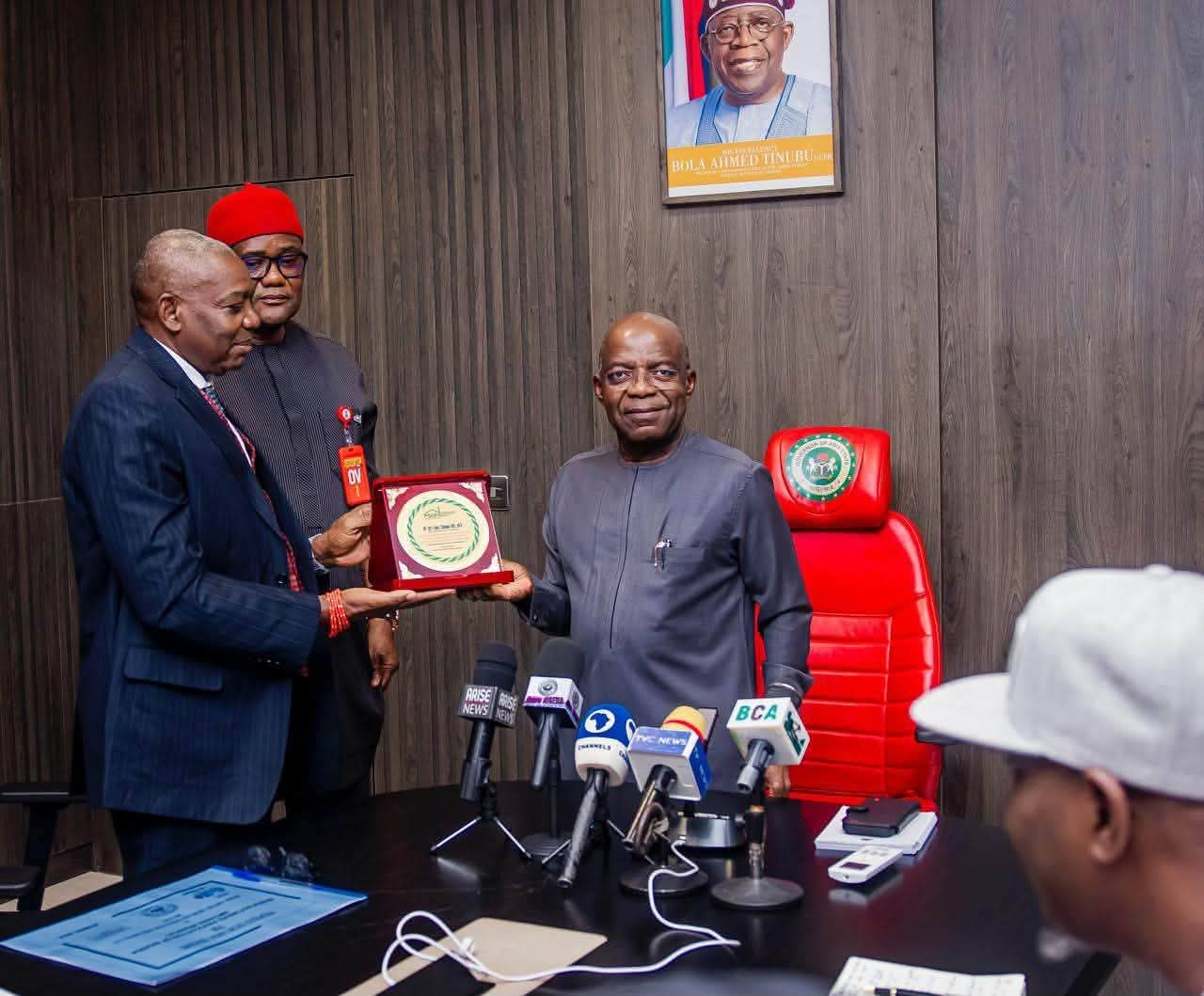
The commendation came on Friday, when the leadership of MAN, led by the chairmen of the Abia/Imo and Rivers/Bayelsa Chapters, visited Governor Otti in Umuahia,the state capital.
The engagement provided a fresh assessment of the economic direction of the Otti administration, particularly its drive to move Abia away from an economy largely driven by trading and consumption towards one anchored on production, manufacturing, investment, job creation and export competitiveness.
At the centre of the administration’s economic agenda is a deliberate effort to rebuild the conditions required for industries to survive, expand and compete.
For manufacturers operating in Aba and other parts of the State, that strategy encompasses simultaneous interventions in roads, electricity, transportation, healthcare, education, urban renewal, taxation, access to finance and industrial infrastructure.
The MAN leadership specifically acknowledged improvements being recorded across these areas, describing the interventions as significant developments for Abia’s business environment.
One of the major areas attracting attention is the administration’s effort to revive industries that had remained dormant or underperforming for years.
The Enyimba Garment Factory, Star Paper Mill and Afro Beverages are among the industrial assets receiving renewed attention as the government seeks to convert abandoned or underutilised productive capacity into engines of employment, enterprise and economic growth.
The significance of the strategy goes beyond reopening factories. It is also aimed at restoring the confidence of manufacturers who require functional roads to move raw materials and finished products, reliable electricity to operate machinery, financing to expand production, security to protect investments and a predictable regulatory environment in which businesses can plan and grow.
Power Supply Takes Centre Stage
Electricity remains one of the most critical components of the industrialisation drive.
Through the administration’s engagement with Geometric Power and other relevant stakeholders, efforts are being directed towards securing dedicated and more reliable electricity for industrial activities, particularly within the Aba industrial ecosystem.
For a State whose commercial identity has historically been closely associated with Aba’s entrepreneurial and manufacturing culture, the power question goes beyond infrastructure.
Reliable electricity is central to whether businesses can produce competitively, employ more people and access wider markets.
The administration’s focus on power is therefore being positioned as a strategic intervention capable of reducing production costs and strengthening the competitiveness of local manufacturers.
₦10bn Financing for Businesses
The Otti administration’s industrial agenda is also being supported by efforts to improve access to capital.
The ₦10 billion Bank of Industry credit facility available to businesses represents another component of the government’s strategy to ensure that viable enterprises are not constrained solely by lack of financing.
The critical task, however, is to translate access to such facilities into expanded production, stronger businesses, more jobs and increased economic activity across the State.
Tax Harmonisation, Multiple Taxation
Another major policy direction is the harmonisation of taxes and the administration’s opposition to multiple taxation.
For manufacturers, predictability is essential. Businesses need to know what they are expected to pay, to whom, and under what legal framework.
The administration’s efforts in this area are therefore part of a broader attempt to create a more orderly investment climate while reducing the uncertainty associated with multiple demands and unauthorised levies.
Governor Otti has equally maintained that businesses should not make cash payments to unauthorised persons, reinforcing the administration’s emphasis on transparency and accountability in revenue collection.
From Factory Floor to Global Market
Beyond taxation and financing, the administration is pursuing an industrial ecosystem capable of supporting producers from the factory floor to the marketplace.
The Aba Trade Fair provides one of the platforms through which manufacturers can showcase their products, connect with consumers and expand commercial opportunities.
The Export Growth Lab initiative, supported by the United Nations Development Programme, represents another dimension of the strategy, with emphasis on product quality, packaging and competitiveness so that locally manufactured goods can compete beyond the immediate Abia market.
This is particularly significant for Abia, where thousands of entrepreneurs and manufacturers already possess production capacity but require stronger access to markets, technology, finance, infrastructure and international distribution channels.
The administration’s emerging economic philosophy is therefore not simply about constructing physical infrastructure. It is about building an ecosystem in which infrastructure, electricity, finance, skills, markets and government policy reinforce one another.
That philosophy is reflected in Governor Otti’s insistence that Abia must encourage production rather than remain primarily a consumption and trading economy.
The policy direction also recognises that technology can transform how businesses operate, but cannot eliminate the fundamental importance of manufacturing itself.
Manufacturing creates productive capacity, strengthens supply chains, creates demand for skills and services, generates employment and provides opportunities for businesses to move from small-scale production to larger commercial operations.
It is this economic architecture that the Otti administration is seeking to strengthen.
MAN Raises Industry Concerns
The MAN delegation, however, also brought to the table the realities confronting manufacturers across Nigeria, including high energy costs, limited access to foreign exchange, inflationary pressures, funding difficulties, insecurity and demands from host communities.
These challenges underline the scale of the task ahead and the need for sustained collaboration between government and the private sector.
MAN consequently called for continued efforts towards reviving more moribund industries, establishing industrial clusters across the three senatorial zones, strengthening action against unauthorised levies and providing additional support for distressed industries seeking to return to full production.
Responding Otti said the recommendations fit directly into the wider industrialisation conversation already unfolding in Abia.
For Governor Otti, the objective is to create conditions in which private enterprise can flourish without government attempting to replace the private sector.
Government provides infrastructure, policy direction, facilitation and an enabling environment, while entrepreneurs bring capital, ideas, innovation, production capacity and market discipline.
The convergence of these responsibilities could determine the extent to which Abia’s industrial revival translates into sustainable economic transformation.
The Governor has also challenged manufacturers to take responsibility for the quality and competitiveness of their products, urging businesses to improve standards, packaging and production processes rather than relying solely on government intervention.
With Nigeria’s large domestic market and Abia’s established entrepreneurial base, the administration is positioning local manufacturing as a pathway towards greater economic self-reliance, employment creation and export expansion.
The message from the Government House engagement is therefore broader than a single meeting between government and an industry association.
It signals an economic agenda increasingly centred on production, industrial revival, electricity, investment, enterprise financing, infrastructure and jobs.
From the restoration of dormant industrial assets to the pursuit of dedicated power; from SME financing to tax harmonisation; from road and urban renewal to export development, the Otti administration is seeking to reconnect government policy with the productive engine of the State.
For Abia, where Aba has long demonstrated that enterprise can thrive even under difficult conditions, the emerging challenge is to transform that entrepreneurial resilience into an organised, infrastructure-backed and globally competitive industrial economy.
That is the larger ambition behind the administration’s production-first agenda: to build an Abia where businesses do not merely survive, but produce, employ, expand, export and contribute substantially to the State’s economic future.