

CHIEF AZIA NWOSU’S MURDER: One Killing Too Many for Awka
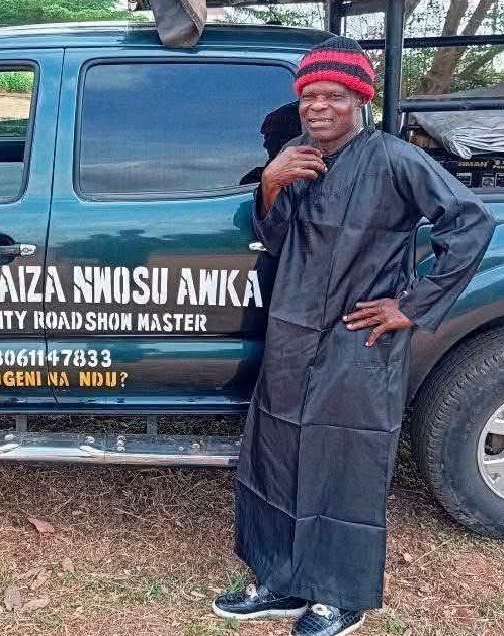
Late Chief Azia Nwosu
By Titus Eleweke
The murder of Chief Azia Nwosu, a popular public announcer, comedian and well-known personality in Awka, is one killing too many for the people of Awka Kingdom.
His death must not be treated as another statistic in an increasingly disturbing catalogue of violent deaths. It must challenge the Police, the Government of Anambra State, the traditional institutions of Awka, community leaders and, indeed, the entire people of Awka to confront an uncomfortable question:
What is happening to Awka?
Chief Azia Nwosu was known as a jovial, engaging and lively personality who brought laughter and warmth to the people around him.
That such a person could have his life violently taken raises profound questions about the security environment in Awka and the direction in which the city is heading.
His death is a devastating loss to his family, friends and associates. But it is also a warning to an entire community.
Every human life is precious. No disagreement, business failure, land dispute, cult rivalry, political disagreement, personal grievance or criminal enterprise can justify the taking of another person’s life.
Whatever the circumstances surrounding Chief Nwosu’s death, one thing must be clear: violence cannot be allowed to become an acceptable method of settling disputes or enforcing interests in Awka.
The answer must be justice, accountability and a renewed determination to protect human life.
How Many More Killings Before Awka Wakes Up?
There have been disturbing reports of killings and other violent incidents in and around Awka in recent years. Too many families have been left grieving.
Too many questions have remained unanswered. Too many cases appear to disappear from public consciousness once the initial outrage subsides.
This should no longer be acceptable.
Awka must ask itself whether it is becoming a city where violence is increasingly tolerated because perpetrators believe they can escape justice.
And if that is not the case, where are the results?
Where are the arrests?
Where are the prosecutions?
Where are the convictions?
Where are the answers to grieving families?
Where is the institutional accountability when citizens are killed and the perpetrators remain unidentified or unpunished?
These are not unreasonable questions. They are questions that any responsible society must ask.
The people of Awka deserve answers.
Who Is Responsible for the Safety of Awka?
The Police cannot carry this burden alone. Security is everybody’s business.
But saying that security is everyone’s responsibility must not become an excuse for institutions that have the statutory responsibility to protect citizens.
The Police and other security agencies must do their jobs. The Anambra State Government must provide the necessary support, resources and oversight.
Community institutions must cooperate with law enforcement. Traditional rulers and elders must use their authority to discourage violence and help create an environment in which criminality cannot thrive.
And ordinary citizens must refuse to become silent spectators.
Awka is home to people with considerable influence in the Police, Army and other security institutions, including serving and retired officers.
It is therefore legitimate to ask: Why should a city with such a concentration of influential security personalities continue to experience killings and insecurity?
Are these connections being effectively mobilised to protect the community?
Are community intelligence networks functioning?
Are security agencies sufficiently communicating with Awka residents?
Are there known criminal networks that authorities have failed to dismantle?
And, perhaps most importantly, have some people become so powerful that the institutions of the state are afraid or unwilling to confront them?
These questions deserve honest answers.
Awka cannot become a testing ground for criminality simply because some individuals believe their influence, connections or resources can shield them from consequences.
Justice for Chief Azia Nwosu Must Be Demonstrated
The investigation into Chief Nwosu’s murder must be treated as a matter of urgency.
The Police and other relevant security agencies must conduct a thorough, professional and transparent investigation into the circumstances surrounding his death.
Those responsible must be identified, arrested and prosecuted in accordance with the law.
This cannot end with statements of sympathy.
It cannot end with promises that “investigations are ongoing.”
It cannot become another case that gradually disappears from public memory.
Modern policing provides investigators with numerous lawful tools for establishing the truth, including eyewitness accounts, intelligence gathering, forensic investigation, surveillance footage, telecommunications evidence and other forms of admissible evidence.
The issue, therefore, is not simply whether the authorities have tools.
The question is whether they have the determination and institutional courage to use them.
And if suspects are identified, the public deserves to know that the case is being pursued through the justice system.
Awka’s Elders Must Look in the Mirror
There is an old saying that the blood of human beings should not be shed on Awka soil,but today what is happening?
But what happens when blood continues to be shed?
What happens when violence becomes frequent enough that people begin to regard another killing as merely another unfortunate event?
What happens when the outrage lasts for a few days and then life returns to normal?
Awka’s elders and traditional institutions must engage in serious introspection.
What is Awka becoming?
What has changed in our values?
Where has the respect for human life gone?
What have we failed to teach our children?
What kind of community are we building for the next generation?
And what practical steps are the traditional institutions prepared to take,not merely to condemn killings after they occur, but to help prevent them?
These questions cannot be answered with ceremonies, speeches and condolences alone.
They require leadership.
The Silence of the Powerful Must Also Be Examined
There is another uncomfortable question that Awka must be courageous enough to ask.
Who knows what is happening?
Criminality rarely exists in a vacuum. Information often travels through communities long before it reaches formal security institutions.
If people know who the violent actors are, how they operate, where they gather or who enables them, why does that information not consistently result in arrests and prosecutions?
If powerful people know more than they are saying, why are they silent?
If influential individuals are aware of repeated killings but do nothing, can the community continue to pretend that the problem belongs only to the Police?
It would be dangerous to make unsubstantiated accusations against individuals. But it would be equally dangerous for Awka to become so uncomfortable with difficult questions that it stops asking them.
The powerful must not be above scrutiny.
Neither political influence, wealth, professional status, traditional authority nor connections within the security establishment should place anyone beyond the reach of the law.
The People Also Have a Responsibility,
Citizens must cooperate with legitimate security investigations.
Anyone with credible information about the circumstances surrounding Chief Nwosu’s death should provide it to the appropriate authorities through safe and lawful channels.
Silence may protect a criminal today, but it can expose another innocent person tomorrow.
At the same time, citizens should not take the law into their own hands. Vigilance must not become mob justice. Community security must operate within the law and respect the rights of every citizen.
Awka needs a partnership between residents, community institutions and security agencies,not a culture of suspicion, revenge and self-help.
This Must Be a Turning Point
The killing of Chief Azia Nwosu should become a turning point for Awka.
Those with influence, resources, knowledge and connections within the security sector should come together,not merely to mourn another victim, but to demand practical answers.
What security measures need to be strengthened?
Where are the weaknesses in intelligence gathering?
How quickly are reports of violent crime being acted upon?
What happens to murder investigations after the first few weeks?
How many unresolved killings are currently on the books?
How many have resulted in prosecution?
What mechanisms exist for periodically updating victims’ families and the wider public?
These are legitimate questions for a community that wants to be taken seriously about security.
Awka cannot afford to become a place where people are afraid to conduct legitimate businesses, move around,settle disputes peacefully or simply live their lives.
No one should assume that because they are currently safe, they will remain safe tomorrow.
Insecurity does not respect status.
Today, it may be another person’s family grieving. Tomorrow, it could be ours.
Awka Must Wake Up
The death of Chief Azia Nwosu must not become another unresolved case that fades from public memory.
His family deserves justice.
His friends and associates deserve answers.
And the people of Awka deserve the assurance that their city remains a place where human life is valued and protected.
Awka must therefore demand more than condolences.
It must demand results.
The Police must investigate.
The Government must support and oversee.
The traditional institutions must lead.
The community must cooperate.
And those who know anything credible about violent crimes must speak through lawful channels.
Above all, those who wield influence must understand that influence carries responsibility. If powerful Awka people have access to security institutions and the corridors of government, then the community has every right to ask what they are doing with that access to protect lives.
The time for passive lamentation is over.
How many more people must die before Awka says enough is enough?
How many grieving families must wait for answers?
How many investigations must remain unfinished?
How many killers must believe that they can escape justice?
These are questions Awka cannot continue to postpone.
Let the killing of Chief Azia Nwosu awaken Awka.
Let it remind us that violence must never become normal.
Let it compel the Police and other security agencies to pursue the truth with urgency and professionalism.
Let it compel the Anambra State Government to treat the security of Awka as a matter of the highest priority.
Let it compel Awka’s traditional and community leaders to look inward and confront whatever social, political or criminal forces are threatening the peace of the kingdom.
And let it remind every resident that protecting human life is a collective responsibility.
Justice for Chief Azia Nwosu must not be a slogan.
It must be a commitment.
And the commitment must be demonstrated by action.